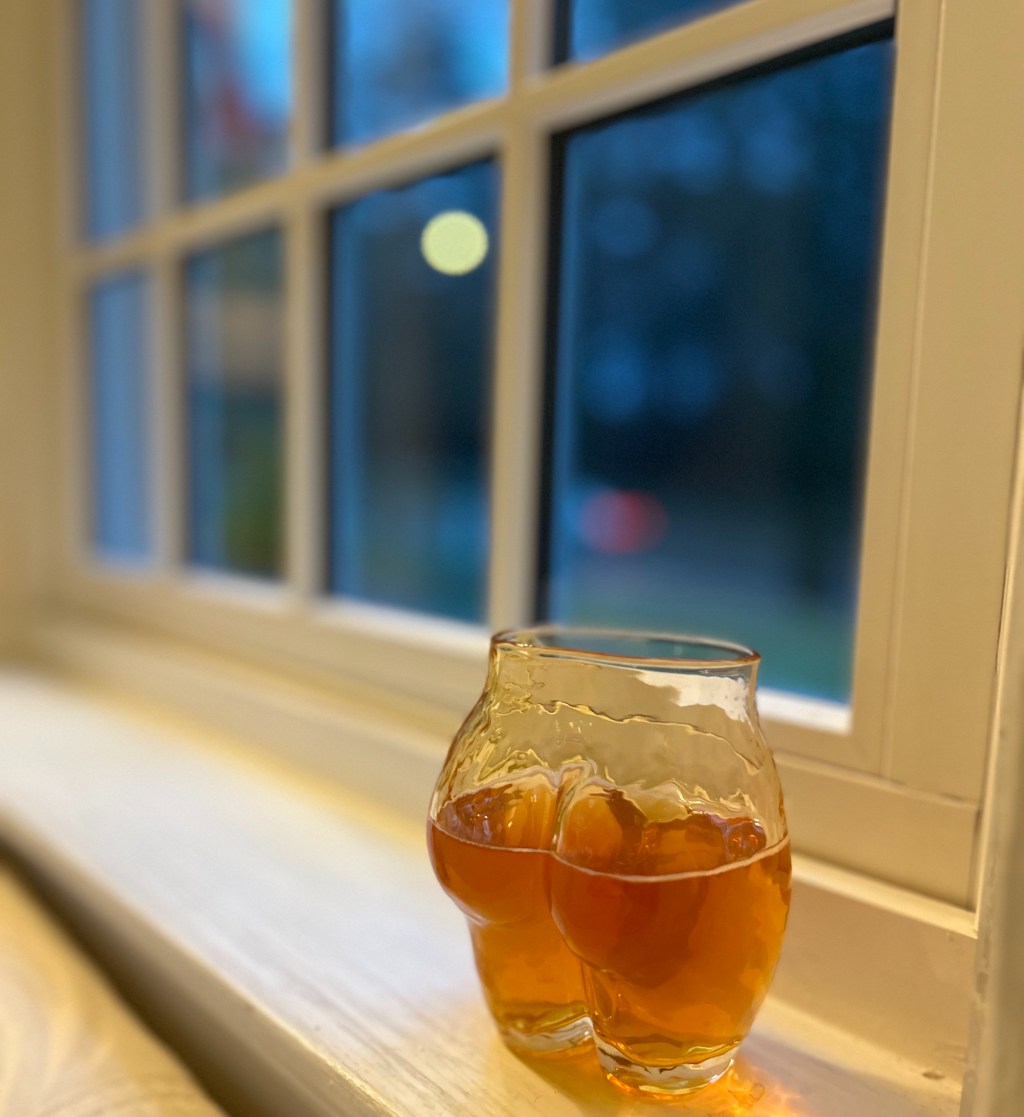
The sky and sea were the same color, lapis shot through with malamute steel, an open mouth with a hangnail moon under which I mostly drifted, though occasionally I stood to get the full, battering force of the incoming tide. Yards away, my friend was chanting up at the sky, “flourish,”relish,” some pleasant, sybillant incantation I slipped in and out of as loosely as I did the waves.
It was the night of the Derby; the horse I had picked at the very last minute, on basis of name alone, had won; I had celebrated with too many gimlets and a confident, unsuccessful attempt to crash a wedding being held on the property; the promptness with which we’d been escorted from the dance hall had propelled us to the beach.
This – pagan, naked, bathed in silver, was the light side, for all it was dark and getting darker. The water was seventy eight degrees.
(That had been the weekend’s great shock – sprinting down the beach minutes after our arrival, braced for the cold, and: nothing. The water was silky, bantam-weight, not so much a reprieve from the sun-blasted air as a change in texture.)
Florida. I’d not been before for pleasure.
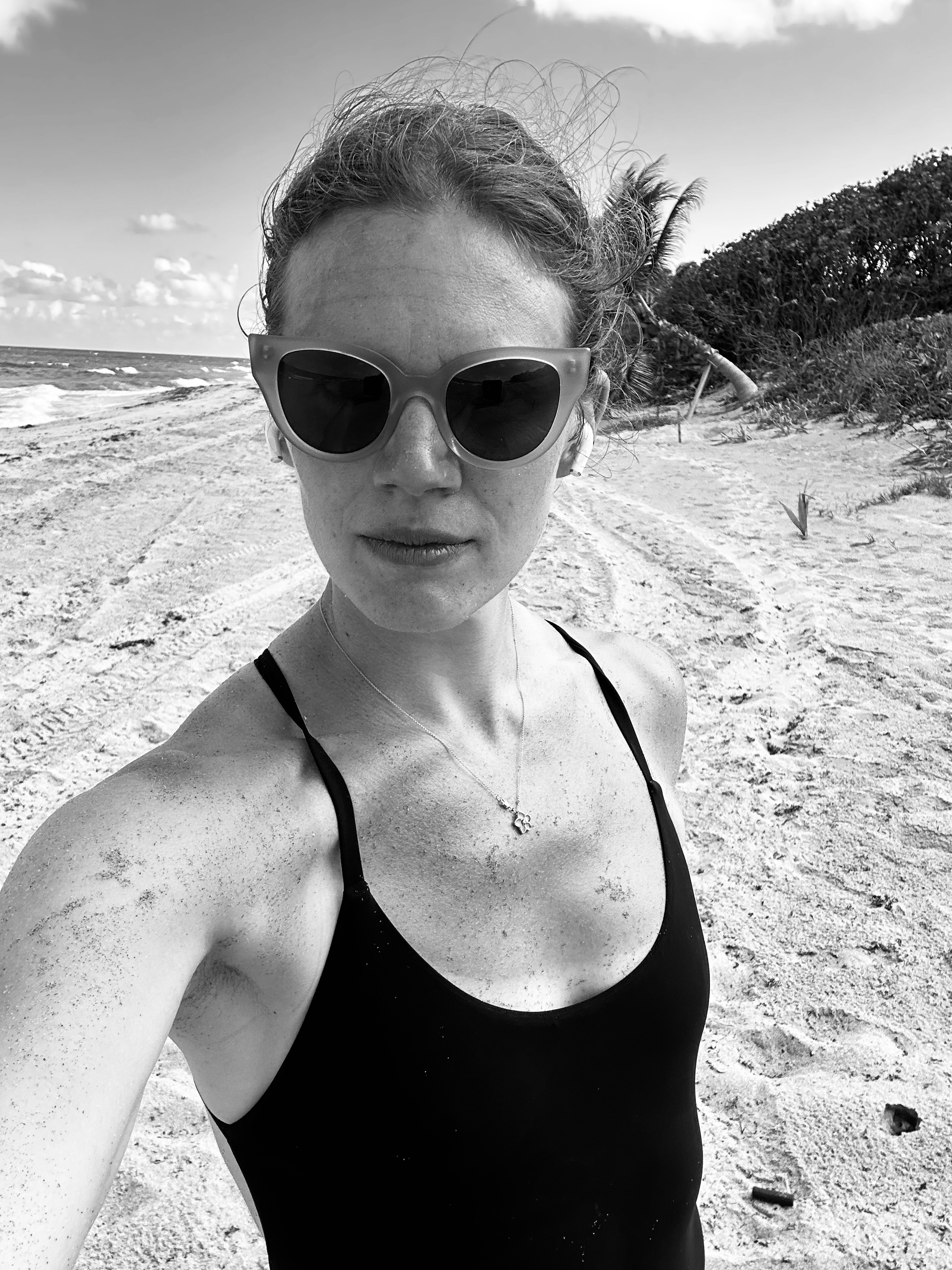
“You’re the fourth mom,” the woman who ran the gift shop greeted me. Everyone else was there for the wedding, or decades older, or both.
The gift shop sold a particular brand of grosgrain-strapped flipflops I hadn’t seen since high school, along with needlepoint belts and wicker purses and polos emblazoned with the club’s crest. I was overcome with the urge to buy whatever was most orthogonal to the rest of the merchandise – assless chaps, for example. Orthogonality was not the intent of the gift shop. I was the fourth mom only because I had broken off from the others in order to write, and I left with a needlepoint belt and a fuchsia wicker clutch and a periwinkle shell in shantung silk.
Florida. I had my first panic attack in the back of a sprinter van in Fort Lauderdale. Spring training, 2005 — scumbled cinderblock and soft sunsets, twice a days in an outdoor fifty-meter pool. Snow not out of the question back home, and here we burned, slithered in the sudden heat. One afternoon, I went to the boardwalk and I got my first and last tattoo — a pot leaf in henna on my lower back. That is what I recall of Fort Lauderdale: sprinter van, sea foam Juicy Couture coulottes, pot leaf tramp stamp, panic attack, pushing spaghetti under my lettuce, Everlong.

At twenty three, I went to Orlando for a Sharepoint conference. The conference center was the size of a small city, encased in plexiglass; its dizzying institutional scale softened by “water features” and fake areca palms.
I hated Orlando as I hated all places where I couldn’t run outside, as I hated all places that required me to be professionally solicitous to the men who did not even pretend to be interested in the product I had to pretend to be interested in marketing.
This Florida was different – lush on almost a jumani scale, buzzing with the stacatto call of green herons and the clean thwack of tennis rackets; the buildings were white clapboard and the foyer was wallpapered in Schumaker’s bamboo trellis and there was not a “water feature” in sight. The caul that descended as I was at the airport, waiting to fly home, was in spite of the trellis wallpaper; certainly, it was in spite of the night swimming and the giddy, freewheeling conversations possible only when one’s children are being lovingly cared for by other people many hundreds of miles away.
The thing was – and it was a thing; a heavy, premonitory thing that increased its weight as the delay extended, and then as we boarded and ascended, some hours later – I couldn’t shake it, for all it was twelve hours early.
It was this sense of iniquitous decay, of consequences playing out. I watched as a whey-faced man, slim and catatonic, was wheeled away from the airport bar. It was not yet eight in the morning. As the delays stacked up, the spaces around the gates crowded with people in electric scooters and canulas, golfers angry about the likely separation from pre-checked clubs, a sprawling bachelor party. People reddened, shouted, attempted to change flights. People who did change flights headed to the bar, or back to the bar, now inordinately teeming.
I was probably just hungover. What did it matter that people were drinking so much, so early? They were probably just trying to extend their vacations. Yet when the flight attendant asked one of the college girls in the adjoining aisle to pull back the hood of their companion to check that he was breathing, I felt darker than ever.
It was closing on evening by the time I reached home. How gladdened I was at the sight of the ebullient maples, the tulips, the quiet, canopied house. Within an hour, I was back on the road, in showers that gave over to driving rain by the time I reached the state line. The darkness had been chased out by something more primal and urgent.
What would you do if a burglar were in the house, Irving asked.
What would you do?
I’d make a deal.
In Florida, I tore through Sirens and Muses, a deft and pacey campus novel with a new-to-me subculture (art students!), and a convincing argument for taking the just past just past as distinct and catalytic history. Occupy Wall Street, which at first seems like just a bit of grounding, burgeons as the novel progresses: students and disillusioned faculty alike become convinced in the internet’s potential to dismantle hegemony, to redistribute knowledge, to turn anger and bitterness over inequity into an endlessly scalable force for change (and, for a few, more capitalistic opportunity).
What I remember most about Occupy Wall Street was that I had gone to see it with Brady the day after we’d first gotten together – an event that, for all or perhaps despite the many months of dreaming and frenetic discussion had hardly seemed forgone.
[Though many of the specifics of that day are hazy, the spectatorial implication of “to see it” is intentional.]
The previous night had started with a miracle berry party; we’d eaten what looked like cherry tomatoes and tasted innocuously sweet and then helped ourselves to spoonfuls of unctuous, cheese-cake like sour cream and lemonade lemons and funnel cake potato chips, and then dispersed to a club on what felt like the fringes of Williamsburg (though most of Williamsburg was fringy then; Diner and Marlow & Sons, with their starched awnings and etched plate glass, their soft lighting and moules frites, were like oases in a corrugated, rattly desert). Toto’s “Africa” was playing while we kissed, I wore a turquoise halter top with a key ring cutout; I was wired off potential that had somehow alchemized into reality, off the adderall someone had given me hours earlier, off the plans a friend and I had been making to put together a grant for a hacktivist non-profit.
(That “Africa” had been playing when we kissed for the first time seemed like a memborably silly bit of incongruity, in fact, it was no less likely than “Umbrella,” or “Alejandro.”)

So that had been Saturday; on Sunday, we got breakfast at Rabbit Hole – a sliver of a place with a liturgically heavy velvet curtain in place of a door – and then we walked over the Williamsburg Bridge and through Chinatown and those gothic, claggy monuments to the greater justice industrial complex until we reached Zucotti Park. It was one of those lambent late-September days that seemed capable of unspooling infinitely, for all that it was a Sunday, with its looming parameter of a three to five hour Fung Wah back to Boston.
The park was an architecturally unremarkable place, less park than plaza, weakly, diffusely green from the chorus of young spindly honey locust trees, and hemmed on three sides by office towers, the stately limestone Trinity and US Realty Buildings, and a cluster of low-rise pizza parlours and fast food eateries. Its eastern flank, where we entered, was pinned by a tee-pee like iron statue, cherry red and unprepossessing despite its 70 foot height. The occupation was only a week old, but already had the feel of a practiced outdoor encampment – part farmer’s market, part music festival, part parade – only notably tenser, with less natural light.
I was, immediately, discombobulated, unsure of where to direct my eyes as we walked around the knot of protesters, past tidy rows of blue tarp shelters, a medical tent, a kitchen, a library. There was a smaller group making signs, and a drum circle, and a few disjointed groups of people haphazardly strumming acoustic guitars. Brady and the friend we had met up with just before entering the park engaged with the pair of young men holding up Fuck the System signs and the guitarists with friendly, genuine interest while I hid, stiffening, behind my sunglasses.
These were earnest, righteous people, most of them my age or just past, with bullhorns and posters and chants not entirely in sync. At the marathon, at the end of the lane – those were the few places in which I could shout, earnestly, with passion and vigor. To shout at a system, at the invisible man: what if the man never came, if the system remained indifferent? I felt tender towards the protesters – how vulnerable, to be so nakedly, publicly angry – and uncomfortable, uneasy. Un. Was I, in my lack of anger, in my interiority and contentment over my comfortable life, part of the system?

The truth is, I have never been comfortable with earnestness, particularly. Earnest righteousness, especially not. Choral anger, also no.
I recall the fiddler, beautiful, elegant hands slipping bottles of juice and kombucha from the top floor cafeteria of the university gym into her backpack. They owe me.
They probably did, but who was they?
Or, the knots of urban farmers congregating in our big, long living room on Henry Street, talking about dumpster diving from the Trader Joes on Court Street, weaving coasters out of plastic grocery bags. I was not opposed in the least to either practice, only – it seemed to make a midnight ordeal out of the simple act of feeding oneself; it was less about eating than about not wasting. I have too many coasters, one woman said, But I don’t know what else to do.
The farmers were more earnest than angry; earnest, despairing, devoted to living in accordance with their beliefs: as lightly as possible. By day, they planted lettuces and caribbean herbs on roofs recently painted white; they delivered composting bins, experimented with growing daikon, sunflowers, musk melon. They spent their livelong hours attempting to make the city a more hospitable and self-sustaining place, and still they grocery shopped at midnight, from still-good but expired food, and handrolled their cigarettes, and would sooner drink from sidewalk puddles than a plastic bottle of water.
My aversion to plastic, at that time, was entirely aesthetic.
Anyway. The point was less that I was not radical, though I was not, than that I was averse to the emotional valence radical beliefs seemed to require.

We left Occupy and walked down to the Hudson, which was full of runners and couples and people taking in the glittering water, the abundant sunlight – people like me. When I boarded the bus to Boston that evening, my thoughts, as documented in my gchat history, were of this burgeoning relationship.
The following May, I moved back to New York – to 44 Wall Street. The apartment building, tall and wide, marbled white on its exterior, had the feel of a dorm, with hawk-eyed doorman and a cavernous, dingy lobby and many banks of slow-moving elevators. My room had one of those plastic sliding doors and a fourth wall that ended an inch from the ceiling.
The weekend after I moved in, my roommates and I would host a party we called “How to Occupy Wall Street, take 2.”
Campuses right now are freighted; it is, again, a time of encampments. Students at Columbia barricaded the doors and windows to the library. They cracked the glass of frenchdoors with a ball peen hammer. Out of a second story window, they hung a flag dedicating the library to a 6 year old Gazan child who’d been killed in an airstrike. Giba’s place.
I think: it is horrible, horrifying, beyond the pale what is happening and has continued to happen in Gaza. And then: what nice french doors; what a shame they cracked that glass.
I think of Navalny, who sharply couched his arguments for democracy in economic rather than religious / destinic terms (“do you want to pay for a war,” etc).
I think: demanding food be sent over your own barricade does not help the people of Gaza, nor the Palestinian villagers in the West Bank. But surely it is better to undermine your convictions than to have no convictions at all.
P comes in as I am listening to the end of a Daily episode on the protests. “They are talking about the war, too!” he marvels. As if it were a secret. P has many questions about Gaza, though he is chiefly concerned with who are the good guys? Who are the bad guys? My refusal to give him a straight answer leads to many variations of this question; he is sure that the manichean answer exists, and can be divulged with enough deft pressing.

Perry gambols down the wood behind the school. It is early mid high spring now, and he is outside most days when I pick him up.
You’re in a good mood, I say.
I like when I have a job.
His job that day was to gather moss for the beds and pillows of Tiny Town.
What’s Tiny Town? Is it for fairies?
It’s for people. What a question!
Why’s it called Tiny Town, then?
There’s another place called Big Town. Everyone goes around saying you’re too small, you’re too big, we’re just right. His voice goes nasal, singsong.
That’s what they’re like, he adds.
I wouldn’t want to go THERE, I say. We are passing by the lake, now free of ice and thinly gleaming.
I wouldn’t either.
Tiny Town sounds more my speed.
I’d like to live there when I grow up, he says, dreamily.
 éclaircissements
Leave a comment