
Here was a night, mid-May, that dropped into the thirties. The pregnant wren had endured a week of blustery rain; the mudroom, in these conditions, gets no light at all. I was sorry for her, and then, once her chicks were born, anxious.
A newborn carolina wren is a goofy, fragile thing – goofy and fragile in equal parts, I hoped. They were not gamboling about a paddock hours after birth. All I could see of them, in the moments where the wren dared leave the nest, were upturned beaks, outsized and yawing.
It was cold, and then colder and the rain lashed the windows and the roof. Oh, why couldn’t it be spring? I read every entry and reddit thread I could find on newborn carolina wrens. There were many such threads, for, in addition to its two bit trill, the carolina wren is known for building its nest in unconventional places – the inside of an open chest freezer, for example, or a bag of potting soil. The redditors were of the collective opinion that the baby wrens would be fine. Don’t move them! Well, I knew that much, at least!
Still, I worried, but I wouldn’t call it intuition.
The next morning, the mother had the chicks hubbarded under her wings. The rain had stopped; in the gardens, tiny fuchsia cracks appeared in the bright, obdurate green of the peony buds.
Well then. The wrens had survived the slough of despond. I spent the day thinking little of them. It was only at night, after the kids had gone to bed, that I stole into the mudroom, peering into the empty nest, found they had not made it after all.
The mother wren didn’t give up right away. She came back to the nest to sit on the one egg that never hatched, and what remained of the ones who had. She looked unsettled, or I was anthropomorphizing. She sat for shorter and shorter periods, and then not at all, and then Brady moved the bag to the garage.
The dog came two weeks later. This – for me – was a matter of baby wren replacement, though it did nothing for the wren.

The dog is part greyhound, part german shepherd; russet brown and fast. He will chew anything in reach, and has already learned to nose up the latches to any door we shut; he is, on the prospect of rabbits and squirrels and fat robin red breasts, an eternal optimis. Also, an early bird: at five on the dot, he wakes up and nudges any uncovered foot or arm or head with his wet nose. Back to bed, we say, but it’s borrowed time.
The dog goes everywhere with me, even to the porch on a hot day when he has the run of the air-conditioned downstairs to himself. Most of the doors are rent, for he cannot bear to be formally shut out, even inadvertently, and we keep putting off cutting his nails. He will ferry anything— large, bulky things like duvets, tiny gimp braids—in his both; he swipes them idly as he’s passsing, the way I swipe at the pieces of blueberry muffin the kids haven’t finished. The trick is to ignore him, but sometimes he cottons to this, especially if you are not good at pretending, or patient,. Then you have to offer him another, better thing to trade. We go through three pigs’ ears a day.
Also: along the skirting boards and among the sofa cushions collect little bits of plastic that look like wide screws. These are the eyes of stuffed tigers, owls, dragons, a scottish highland bull.
I think about training the dog the way I think about educating my children: in the osmotic passive. When he arrives, the dog knows: sit.
I start to run with him, a few times a week, a route that is half wooded road and half trail. The first few weeks, when I get to the trail part, I unclip him. He cavorts and bounds in long, irregular ellipses around me and the first mile, I don’t interfere at all; it’s only when we’ve descended into the lowest-lying stretch of woods before the field before the road that I start to call for him.
Gimlet, come! Gimlet, come! That is what that stretch of woods sounds like. Always, I’m two future selves arguing: the see, he came back self, and the you idiot; he didn’t self.
There’s a night I run him after a day of little activity, and the second I let him off leash, he’s just zooming away, positively blind to the trail. I spend the next ninety minutes casing the forest, and then slink off to the police station to pick him up. The you idiot self wins out, and for now, the dog runs clipped, at my desultory pace.
************
An astronomist gives a lecture on space. My grandmother is turning ninety and all seven of her children and their children and their children’s children have come to New York to celebrate and contemplate the heavens. In an old playhouse in Bedford, we listen to the grind of a dying star and look at closeups of Jupiter’s eye and the super-massive black hole at the center of our galaxy. The black hole is blurry, with a bleeding orange penumbra – but also awesome, in the original sense. Neptune looks like the oysters we are soon to eat. Moon, moon, my nephew says.
The astronomist explains orbits to us: with enough height and enough speed, an object will fall at the same speed as the earth spins. This feels like a neat trick, a sophisticated wind at your back. Surely I have read this before – hadn’t I passed introductory physics? But, as with many concepts, this is the first time I hear it and listen: in a general lecture for an all ages crowd.
All these heavenly bodies eons away get Per thinking. Time machines: are they impossible to build?
Impossible? Who am I to say?
Time travel was a staple of some of my favorite books as a child, like Running Out of Time, and the series with the kid on the bicycle, cycling through King Arthur’s court. But in those stories, the act of time travel was always, at least originally, accidental; the point was what happened next. It was only A Wrinkle in Time that made the how explicit. I remember, still, the little drawing of a piece of string folded in upon itself.

The internet is a cesspool, and 95% garbage, but on the other hand, there are hundreds of subreddits and stack exchanges devoted to earnest discussion of time travel.
You need a wormhole, I venture.
What is a wormhole?
I start to say that it’s a tesseract, then stop. A tesseract is what a wormhole allows for, not what it is. I begin again. It’s what happens after a star dies…
Again, I stop, because I’m pretty sure I am describing a black hole, and maybe they are related, but maybe not.
Perry, at this point, is ready to move on; time travel is a passing curiosity; not like Pokemon. But here I am, with this abstract job (looks at computer all day), poor time management, and almost no post-apocalyptic skills; I only just learned how an orbit works, for crying out loud.
Someone on reddit writes that anyone wishing to understand wormholes and time travel should read what Morris and Thorne have to say on the subject. “The bible,” the poster says. I find the bible on an academic research site: “Wormholes in spacetime and their use for interstellar travel: A tool for teaching general relativity.”
The paper’s goal, per the authors, is “to derive and discuss the traversable wormhole solutions in such a way as to make them readily accessible for teachers of elementary relativity classes, and to beginning relativity students.”
Okay; I think. For surely I qualify in the latter bucket, given I know nothing of relativity, general or otherwise?
My professor friend who hates space nonetheless prints out all nineteen pages of the paper for me, which I set about reading that night.
After several readings, here are what I take as the requirements for a traversable wormhole:
- A big warping of spacetime (eg: bowling ball in a trampoline), similar to a black hole’s, but, crucially, not a black hole, because the gravity in a black hole, to say nothing of the radiation, rule out two-way travel. (You can check out any time you like, but you can never leave.)
- Matter or macroscopic field with radial tension that “one” could thread through the wormhole, like one of those two-ringed basketball net-type playground climbers. This bit, field and tension, is essential – it’s what would keep the wormhole’s throat open.
- A civilization capable of making this matter / field.
- Tidal forces low enough to not tie or smoosh or twist or otherwise wreck a person in a spaceship traveling through it
- Also minimal radiation flux
- No horizons on either side of the throat
- “Assembly should require much less than the mass of the universe and much less than the age of the universe.”
The boys and I pour over the embedding diagram provided in the paper: a sheet of paper curved over itself, two holes, a webbed throat that narrowed and widened again. We do not need the math to understand the drawing.

The first time I read the paper, I treat the equations for wormholes as I do the footnotes in Infinite Jest (which is to say, I skip them).
The second time I read the paper, I write down the equations, some of them. I don’t know what I am writing from Adam – what is the little circle with the hatpin slash? I don’t write them down to better understand them; it is just fun, making these unfamiliar shapes.
The genesis of the paper is an interesting one:
In 1985, the astrophysicist Carl Sagan was nearing completion of Contact, his first and only novel. The characters in Sagan’s novel, separated by many galaxies, needed to meet. Sagan had been relying upon a black hole to deliver his human protagonist, Dr. Eleanor Arroway, to the planet Vega, but as the publication date neared, he worried that this approach violated the laws of gravitational physics. He sent a draft to his old friend Kip Thorne, asking for his advice.
Thorne had, at this point, spent years researching black holes, neutron stars, and gravitational waves. He knew that nothing came out of a black hole, and nothing came into a white one. Sagan’s method of intergalactic transportation would have to be shifted – but how?
He was in the family car, headed back from his daughter’s college graduation. He thought there might be an answer in the Einstein field equations. In fifty lines, he’d worked it out.
The properties of these solutions made it into the galleys of Contact. The novel would go on to introduce the concept of wormholes to the public; Thorne, who’d previously been a black hole guy, now took up the study of wormholes and time travel in earnest.
See, it is not such a crime, wanting fiction to be accurate. In some cases, such a goal can birth a new field of research.
In the fall of 1985, Thorne’s final exam on general relativity consisted of a series of prompts and equations whose solutions were the physical and geometrical properties of a traversable wormhole connecting two different universes.
“I was struck,” he noted, at “how hidebound were the students’ imaginations: most could decipher detailed properties of the metric but very few actually recognized” what it represented.
I want to know about these very few. Where are they now? What did it feel like, realizing what they had solved?
“Show me a snail hole,” says Irv.

************
Irving has a great fascination with relativity. I cannot name a person or historical event without him asking how much older is this person than Papa, was Papa alive when this event transpired.
“How old is your great great great great grandfather?” he will ask. Now, he means. Not when he died. By instinct, I am all too impatient with this line of questioning, too typically adult, too literal. It takes some resolve on my part to reframe it as an exercise. Eg:
Assume each great has an average age of sixty, and there is an average of 25 years between them, and the most recent passed away fifty years ago.
One hundred eighty five. I am pleased with this approach. Teach a child to derive –
“What?? That’s way too old.”
The incredulity of five!
I don’t know I don’t know I don’t know.
“How old will you be when I am sixty?”
“Ninety one.”
“How old will you be when I am one hundred?”
I will always be whatever you are, plus thirty one. Thirty one is the constant.
“So, when I am infinity, you will be infinity plus thirty one?”
Algebra comes from al jabr, the rejoining of broken parts, from the verb jabara, to reunite. In its original form, algebra was verbal. With kids (and adults, if we don’t think about it too hard); it still is.
******
I learn about the Aarne-Thompson-Uther Index from Sheila Heti, who is trying, like a lot of us, to understand her relationship with her computer. The ATU is a classification system for european folktales, and the classifications have that nordic sort of pithiness to them; they are plain and oblique at the same time. “The Maiden without Hands.” “The Girl as Flower.” Heti is interested in the modern-day relevance of Type 562, “The Spirit in the Blue Light,” both literally and philosophically, but I am drawn to “Rescued by Sister” (Type 311), because the heart of the book I’ve been writing (or, mostly, thinking about rewriting) is a drawn out sisterly rescue.
One example of Rescued by Sister is a norwegian folktale called “The Old Dame and her Hen.” Here is how it goes:
An old widow and her three daughters live alone on a hill with just one hen, and then that hen wanders off and is snatched by a wicked hill troll. The oldest daughter goes looking for him, hears a voice saying “your hen is tripping in the mountain,” and falls into the hill troll’s trap.
Will you be my betrothed, asks the hill troll; i’ll see to it you have everything, gold and food and clothes. No, the sister says, and the hill troll kills her.
The second sister goes looking for the first and the hen; falls into the trap; rejects the troll’s proposal, meets the same fate as her older sister.
The youngest sister goes looking for her sisters and the hen, and likewise falls into the trap, but she plays along. Sure, she’ll marry him. She tricks the troll into bringing food and gold to her mother; she kills him with a forked spoon; she uses the troll’s special revivification salve to bring her sisters back to life.
Revived by sister: why is there no taxnonomic classification for this?
The first and second daughters are killed by the hill troll for their honesty; the youngest lives because she lies. My younger sister is neither duplicitous nor sly, but still, I know she’d best that troll. Me, I’d lie out of fear and politeness; I am not quick on my feet, nor brave (nor, for that matter, brazen, heedless, reckless). Besides, as first sister, isn’t it my responsibility to ensure we have chickens to spare?

In the German version, the troll is a sorcerer; the pretext for murder not a proposal but a locked room, containing the remains of prior wives, and an egg, to be safeguarded and returned to him unblemished upon his return. Here, the slain elder sisters are revived because the youngest reassembles them. Here, the sorcerer is locked into his house from the outside and burned alive.
The sorcerer is testing the women, where the troll, one could argue, was merely asking a question in the hopes of hearing the only answer he’d accept. The details in the german version are more gruesome, and odd. The egg brings to mind tenth grade sex ed, when we were given eggs to mind for a school week. The eggs were specially marked, to prevent substitution.
I’d been expecting one of those dolls that pees and cries and tracks, remorselessly, the teenage failure to respond. Not an egg. The egg was silent. It had no needs, other than to be gently ferried about my day. The egg fit into my life. It may have set me up to expect the same from my children.
In both cases, the folktales and tenth grade sex ed, failure to pass was the entire point.
******
My friend A and I are walking to meet my sister in Fort Greene. We are tardy, because we have been gabbing in our hotel room and drinking little cans of pinot noir from the mini fridge and time has slipped away. It is a hot night in july, a summer friday night in new york and it will be quiet, i think; i remember how quiet fort greene would get on a summer weekend; conspiring to make me think i should be somewhere else, even though it was nice having the run of the place. But tonight it is thrumming, and everyone is young. On the plaza beside the whole foods on Fulton, women in crochet bikini tops are dancing in whipsawing segments, like a snake, while a few older men hand out little bottles of syrup, pink and lilac and clementine.
My friend A and I are thirty seven; she in a sundress and me in long, low-slung black shorts that I wore all over Mexico City and to conferences, dressed up with a cheesecloth blouse. Are we too old?
We meet my sister on the north side of the park, where she has been waiting for twenty minutes, distracting herself with passing dogs. She is wearing a baggy white tee shirt stamped with obscure italian insignias, and men’s shorts and running sneakers. She is luminous and just the right amount of dewy. “Why are you pronouncing it ‘DEE-kalb; it’s dek-ulb,” she tells me.

We sit outside of the italian restaurant below my old apartment drinking vermentino or campari with lots and lots of ice and talk about Gaza and Mamdami and people from our childhood and my sister’s friend’s job at a sex dungeon and the not so secret key parties in one of our towns. My sister says sex dungeons are filled with people who play board games, which is not her thing. I needle her about her exes and she and A try to talk me out of my blind faith in the new york times while other young and dewy people wait in line for gelato. My sister keeps calling out to people she knows; it is past ten at this point, and everyone is on their way to somewhere else. A and I are confused by this: who stops for gelato on their way to a bar, or a club, or even a house party? A couple walks past, the girl in a tiny black dress printed in large cabbage roses, ass pretty much fully out, apart from what his hand is covering. Maybe it’s the early aughts in me, but I don’t like a tiny dress, I say. I am ribbed for this, too; no one buys my excuse that it’s the proportions I’m objecting to.
It’s eleven and my sister is going uptown to rescue a friend and A and I are going to a bar my sister’s roommate recommended, no gelato for us. Are we too old? We keep asking.
You’ll be fine, my sister says, which isn’t a no.
Are we too old? The bouncer or else he’s just a man standing outside overhears us; no, this place isn’t like that, you’ll see.
The bar has red walls and new wave synthy music and we probably are too old, but it is midnight and quieting. The man at the other end of the back room, dark curly hair, leather jacket keeps looking at me like he knows me; like he’s trying to work something out. His pupils are enormous.
Are we too young?
*********
And now it’s August. Windchimes clink through the open window; only Ottelie is asleep when the 6:09 cargo train lows. Irv sits beside me on the sofa in the blue room, looking at George Bellows’ boxing series, all that fleshy desperation. The dog bounds in, puts a paw across the keyboard, springs from ottoman to sofa and back and Irv and I slide the laptop away and head outside. Irv speeds on his scooter – I have to keep hollering for him to slow down – and the dog pulls, eager to catch up, while I dig in my heels, because it’s early and I’m in a short nightgown and falling down glasses and obstinate besides.

The song of the summer is, unfortunately, “Steve’s Lava Chicken.” All the kids know it long before the movie came out on streaming.
“Don’t say ‘hell,’” I keep reminding them. They come up with their own radio edits. Bell, Heyyyyy. El-el-el.
She’s humming the h-word, Irv says, of Ottelie.
Humming doesn’t count.
But she’s humming hell!
What am I going to do: forbid her from humming?
One night, Perry is at a swim meet and Irv and Ottelie and the dog and I walk to get ice cream. Ottelie is wearing her sea horse costume, velour snout bobbling against my shin. She switches from humming hell to belting “Wrecking Ball.” A storm has come and gone and the summer sky is cotton candy pink, glowing the panes of the new cast iron windows that have gone into an old, old house. We place ourselves along the sidewalk so that our shadows are exactly the same height.
The cars are swallowing us, Irv says. We watch ourselves disappear beneath the three-dimensional metal, tire, trickles of Espresso and AC/DC, only to reappear a moment later, long and flat as ever.
This is the first summer that all three kids are swimming; if Ottelie is less confident in water above her head, she is also more cautious; content to watch as Peregrine dives after brown trout with a clear pink bucket. Irving follows the slavic cycle of plunge:warm, lying chicken wings up on the sun-baked dock.
Peregrine starts his dives standing straight, with his hands in a vee. Try from a lunge, I urge; fling your arms out as you spring over the water. If there’s one movement I’ve mastered, it’s a dive, and it’s funny; I don’t recall being good at them when I was a swimmer.
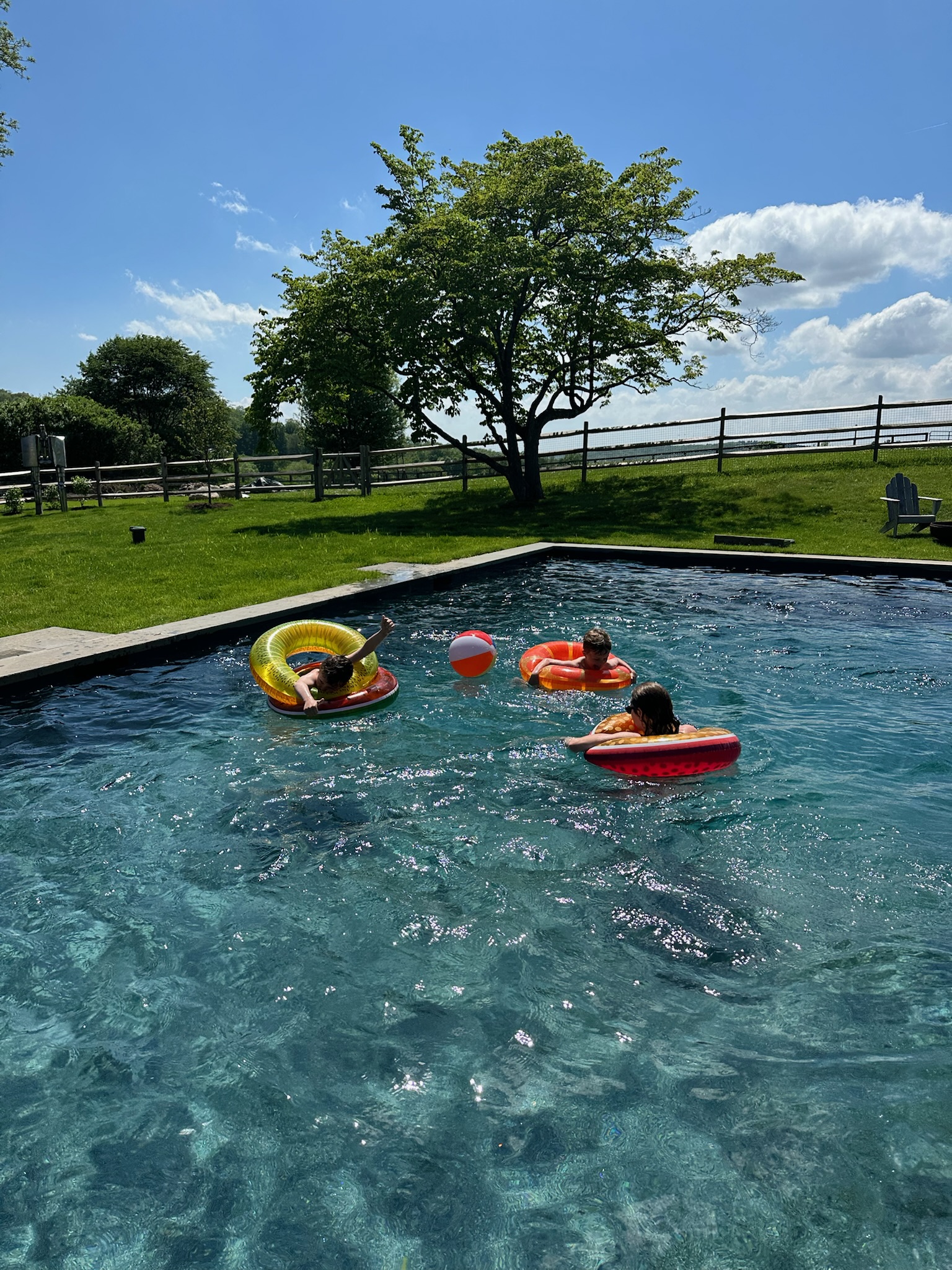
He keeps his mantis dive, but allows me to talking him into trying butterfly at the town meets. He doesn’t know butterfly, he says, but then again, no one does; there are five, six heats of eight and under girl’s freestyle, three of boy’s, and just a single – a lean single – for fly.
The first time he tries, his goggles fall down on his cheeks, and the stroke doesn’t resemble a butterfly so much as, perhaps, a caterpillar, bunching its way along a twig. The second time, the googles stay on; the bunching is pretty much the same. Afterwards, I think, as he’s coming towards me, that he’s going to say that’s it; he tried and it’s not for him, MOM.
“I need to practice my stroke,” he says, instead, and heads back into the water.
I watch him porpoise off the bottom for a while; past when I’d think he’d be bored with it, past the first and second calls for the freestyle bullpen. This time, for the first few strokes, both arms come out of the water, milling more than sculling, but at least milling more or less in sync. True, it’s freestyle he’s supposed to be racing – but you know what they say about freestyle: anything goes!
***********
Towards the end of the novel Somebody’s Fool, an English professor at a community college in upstate New York asks his students to explain the difference between knowing and knowing about.
The students, at first, are stymied.
So far, the professor says, he’s asked them to write about things that matter to them, and instead they’ve written about sports, movies, music.
One of the students points out that this is exactly what is covered in the local alternative paper the professor himself edits. The professor concurs. So what does he know?
The professor tells the class that he has only been a parent to one of his three sons. Two decades earlier, he and his ex-wife had divorced, and she had moved with the eldest and youngest to West Virginia. The consequences of this decision have been coming to light and accelerating over the course of the prior few days that constitute the novel.
I read this on the amtrak somewhere between New Haven and New London and think about it through much of Rhode Island. At this precise moment, I know about the May German privacy ruling and z-indexes and linking datasets and a qbit about traversable wormholes, just as, at other moments, I knew about french decadent literature (tortoises slowly suffocating under the weight of their bejweled shells), and the norman invasion and linguistic dysphemism (quain -> queen / knave -> knight) and javascript event implementation and, presumably, stoichiometry.
What I know about is finite and mutable. But what I know – that’s cumulative, more or less. There’s some meta overlap between knowing about and knowing: pattern recognition, relating. And then there’s a raft of physical knowledge: how to run, how to control the edges of my skis, what efficient swimming feels like. How to hold a baby.
I don’t know what I’m getting at with all of this, except that while I’m certain to forget what I’ve learned about wormholes, I won’t forget how to learn.
 éclaircissements
Leave a comment