
It started last spring: this nagging worry I might be failing my eldest child by not enrolling him in enough activities. At the time, he was fencing once a week, and playing baseball on Saturdays, at least when it wasn’t raining too hard, and this seemed like enough, especially as the fencing was something he endured more than enjoyed; the instructor, an acrobatic young Macedonian, was punctilious, exacting, and we were always late, running breathlessly in, hurriedly trading street shoes for indoor shoes, me apologizing but never actually managing to get there any earlier. It seemed like enough, and certainly, I hadn’t thought about what he’d be doing some four months hence, but then I was walking with a friend one soft May evening, before a lecture we were both going to on capitalism in early american literature.
What is Perry doing this fall, she asked. She was worried whether two sports, three practices a week plus a game, plus the play and language classes come fall might be too much for her daughter – it was hard; she wanted to try everything! – and a different worry stole over me, along with a childish defensiveness. My son did not want to try everything, or even many things. Was there something wrong with that, and with me, for enabling or allowing it?
I am a self-absorbed and fairly selfish person, with persistent and unwarranted faith in elastic time, and these traits leave scant accommodation for anyone else’s activities. I want my children to be happy, and to find things they like or even love doing, and have the freedom to do them – and, as with parenting or general instruction, I want this to happen of its own accord. Surely, a child who is musically inclined can avail him or herself of the ukulele that lies under a heap of dress-up costumes in the playroom, or figure out the correct four button combination required to turn back on the old electric keyboard. There is the grim, electric-heated room off the barn that just begs to be turned into a woodworking shop, or even, with enough persistence, a potter’s studio, or a children’s theatre. There is a chessboard, somewhere, with most of its pieces. Also, we have a dog, and someone needs to train it.
Nonetheless, this new worry that I was failing to provide appropriate enrichment, and, more importantly, appearing to fail at this key performance indicator led me to ask my son what he wanted to do in the fall the following morning, and to fall into a rage when the answer appeared to be: nothing.
You have to do SOMETHING, I implored. He looked at me warily.
“Art class?” he suggested.
“Something physical,” I added, for there is nothing I like more than to pile on conditions.
“Can we talk about this later?” he asked.
“How about the play? Do you want to try out for the play?”
“The play is physical?”
“Well, no, but –”
*****
When Peregrine was ten months old, I took him to swim lessons at the Y on Atlantic Avenue, in Brooklyn. He had to wear a swim cap, and his head was so enormous that one of mine fit fine. I did not expect him to learn to swim at ten months, though I had a vague notion, gained from watching a youtube video of icelandic newborns being tossed into the shallow end of a swimming pool, that his little arms and legs might still have some vestigially embryonic sense of how to move in water, like a late-stage morrow reflex.

At the beginning of each lesson, the instructor, a middle-aged woman, shivering in a long-sleeved red wetsuit, would empty a bag of fist-sized rubber ducks into the pool, and we would spend the ensuing ten or fifteen minutes encouraging our infants to reach for the ducks. No sooner had Peregrine managed to get his fist around a duck than I was to pry it away and return it to the basket. This struck us both as a raw deal. I understood that there must be some evidence supporting reaching as a precursor to the angled overhead glide of freestyle, but at the same time, it felt unduly sisyphean for an infant. Whenever the instructor wasn’t looking, I allowed the rubber duck to advance from fist to mouth, its rightful destination.
On a bright, windy Sunday near the end of April, Peregrine now three, I knelt at his feet, still padded and enormous, almost thorpeian, for his age, and triple-knotted the laces on his new cleats. I had managed to find two pairs of seventies-style athletic shorts, persimmon and grass-green, with white piping; they were pleasingly short, almost raffish, I thought.
It was a soccer program for three and four year-olds, organized by a club, rather than the town, and thus staffed by players at the local colleges, rather than parents. I watched, bemused, as a mop-haired twenty year-old demonstrated toe taps. Peregrine picked up his ball. Ball on the ground, I said. He came over to me and sat down. The twenty year-old had begun to zipper dribble along a line of orange cones. I dragged Peregrine back out to the field. Come on, dribble, like this, I said. He picked up a cone and stared at me through it. The coach ushered the handful of adept four year-olds around the missing cone.
This might have been embarassing had most of the other three year olds not been refusing to leave their parents’ laps, or pulling off their shin guards, or chewing, introspecively, on one of the little plastic field markers.
Peregrine, it soon transpired, wanted to climb the large, flat-topped rock we’d passed on our walk to the field. I tried to hold the rock as a bargaining chip – you can climb it if you play for half an hour, twenty minutes, fifteen minutes. At fifteen minutes, I gave in, and led him over to the rock.
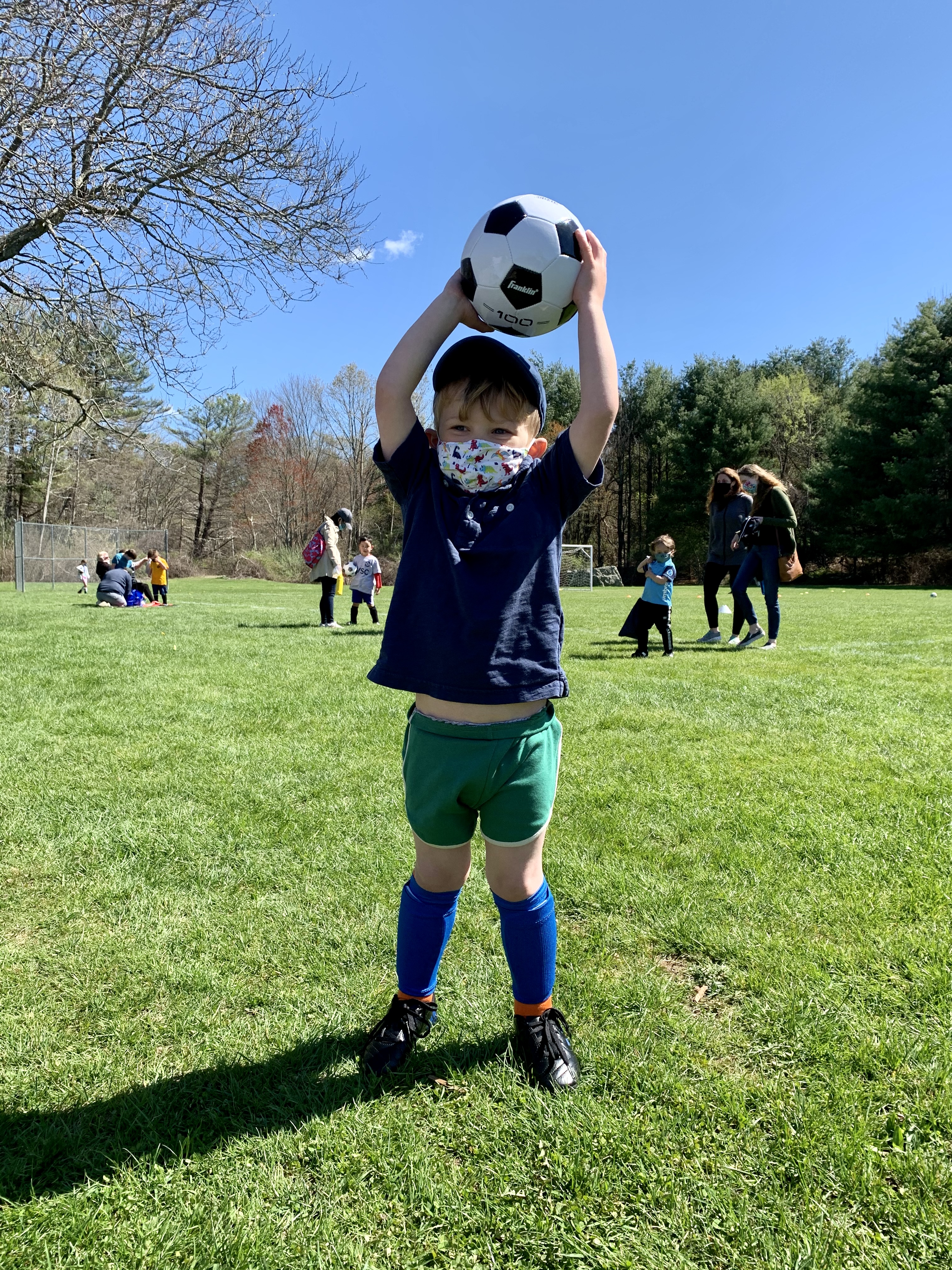
The remaining spring sundays passed in much the same way. My husband thought it was silly – he wasn’t playing, or barely playing, so why bother? But it was time outside, and there wasn’t much rhyme or reason to three, and he liked climbing the rock.
I did not expect to care whether my infant was any “good” at swim lessons, but it was somewhat of a surprise, as three became four became seven, to find this sentiment unchanged. The memory of fifth grade floor hockey was, after all these years, still acute. “Aren’t you supposed to be good at this?” someone had asked me, after I’d botched yet another pass. I was supposed to be good at floor hockey because I played ice hockey. Until floor hockey came along, only a few of my classmates – the other hockey players, all boys but one – knew that I was equally dreadful at ice hockey, because I played in another town.
Maybe it was my own experience, as a late-blooming athlete in a sport with zero hand-eye coordination requirements, that colored the expectations I placed upon my children. Even now, when Irving intercepts the opposing team’s ball, I am mildly astonished.
The boys and I could have rowed along quite merrily in this just show up, climb the rock mode for who knows how long, had the youth industrial sports complex not intervened. By second grade, it’s hard to find a sport that doesn’t come with at least a three day commitment; many of the programs have try-outs, and I notice, at Irving’s soccer (still, blessedly, once a week) and school events and other gatherings of parents, that the conversation has shifted in tone: now the children need to be proficient, even at sports they have never played.
I catch up with a coworker whose son is Perry’s age. He is playing soccer three days a week.
I don’t have a problem with him not playing sports, she says; the problem is that all of his friends do. If he wants to hang out with any of them after school, it’s this or Russian math.
That’s the real rub, I suppose.
What is Perry doing this fall?
[]
How dreary to be somebody, I should reply. Instead, I ask Perry if he’d like to to try winter swim team, which some of his summer league teammates are doing, and which I myself had done when I was his age. When I’d first suggested it, in that brief spring frenzy, he’d rejected it out of hand, but now he is wiser, and willing to let external factors be the deciding vote. Sure, he says. He has to try out for this team, even though it is a town team in a rec league. Some of the other parents from the summer league had enthused about its light schedule – just two practices and one meet a week!
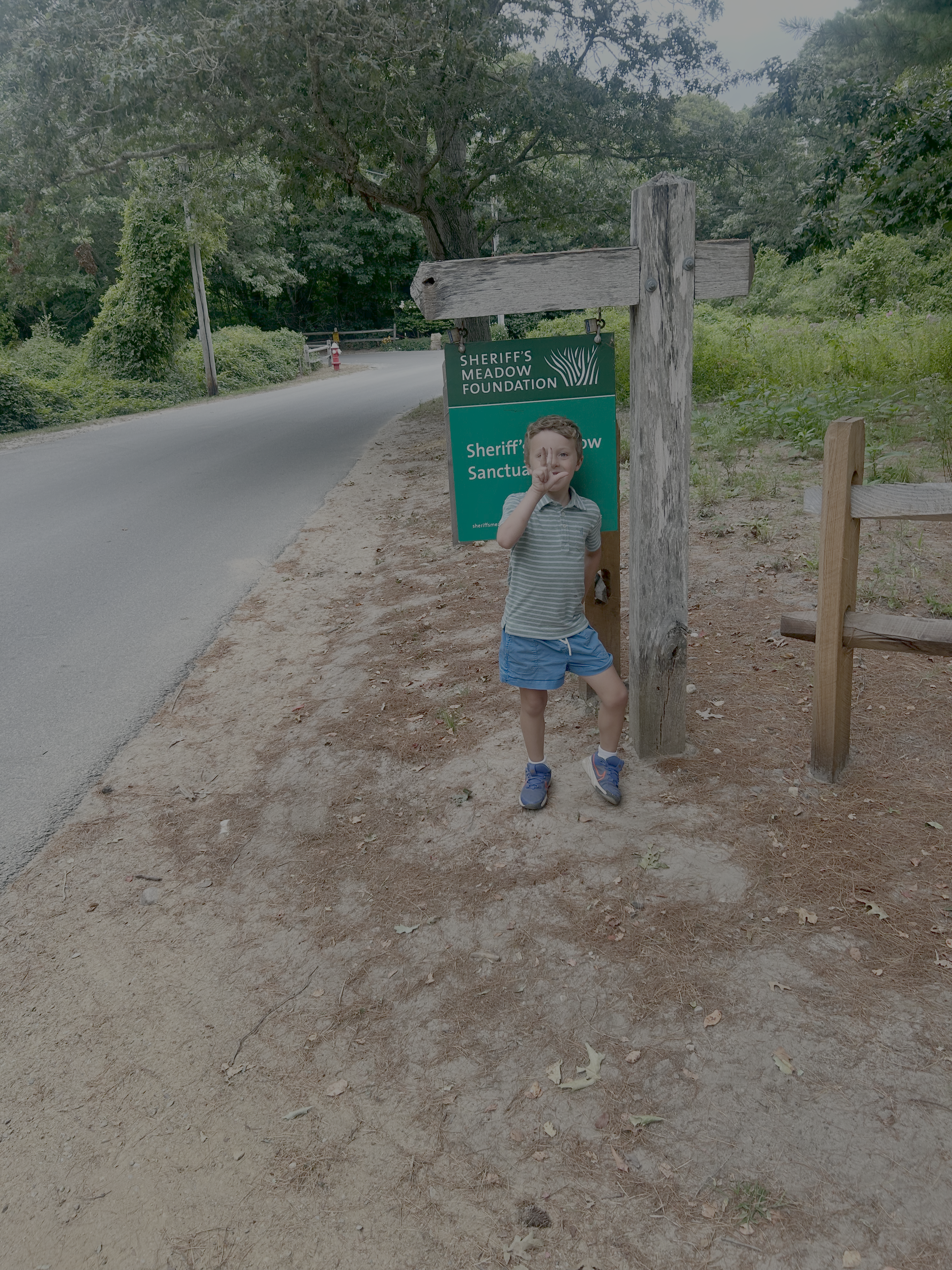
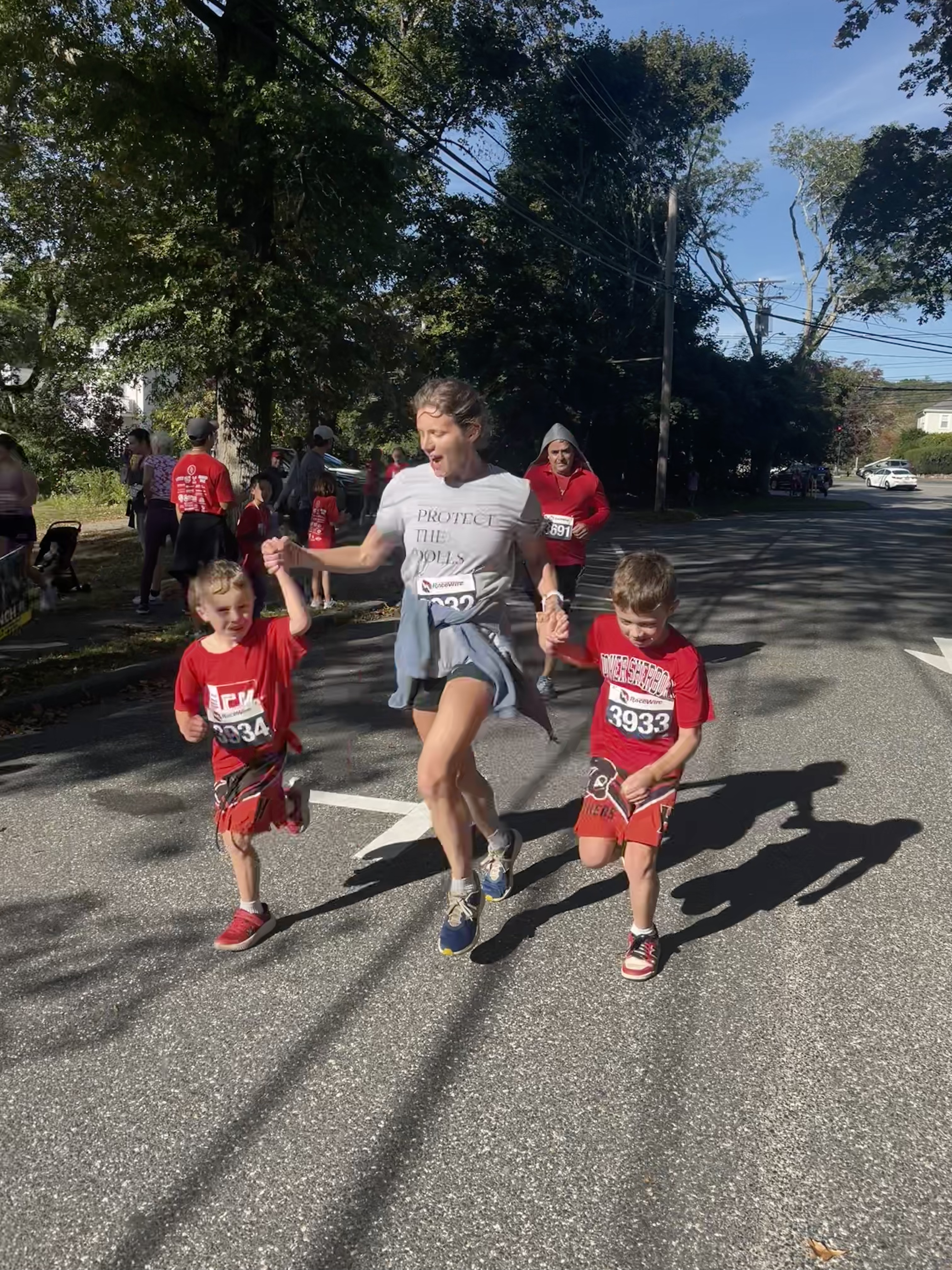
Tryouts are held at a massive youth sports complex off a long, strip mall-lined thoroughfare. Children in basketball jerseys and dragging hockey bags stream towards the entrance, along with the swimmers, telltale in their suits and flip flops in the late September sun.
I hate the complex instantly, with startling vehemence. It feels, with its multiple wings and spectator levels, its vending machines of pucks and hockey tape and basketball socks, designed to ensnare parents into willingly committing their children to cosplay as professional athletes. Irving and I drop Perry off at the corridor leading into the competition pool, and then we wander in and out of a figure skating practice, a girls’ hockey game, a basketball game, a boy’s hockey game. I buy Irving a cup of skittles from a vending machine that allows you to select up to six colors, which the machine deposits in the cup in tidy rings, and I sit in the stands of the rink with a friend and her son, absentmindedly plucking lime and lemon skittles from the cup. The players below are confident, aggressive skaters; they trap and pass and slice with a bold elegance that is nonetheless disconcerting in its camacotz uniformity. This team is in fourth grade, my friend tells me; she knows a few of the boys. I am further unsettled by this information; it is one thing for one or two players to be preternaturally skilled at nine or ten, but for the entire team to be playing at this level? When Irving says he’d like to go walk around the wooden track that encircles the basketball court, I willingly oblige.
Peregrine doesn’t make the winter team. I’m annoyed by this outcome – not that I thought he was owed a spot, but that there had to be spots to begin with – and annoyed at my own annoyance, for I had been dreading the thought of spending two or three hours a week in the sports complex. Peregrine is unperturbed by the news. Does that mean he can do ninja with his friend N? Sure, I say, and then find out it’s a coding class. Instead, I sign him up for a development team, which practices at an old, five-lane bubble pool some thirty minutes north of us. “There are no skills. We must start at the beginning,” the instructor tells me, after the first practice. At this point, I’m happy he has a spot at all, and contrarily pleased with the small, hot pool in this old, casual fitness center – so old and casual that Irving is allowed to avail himself of the medicine balls and free weights and football gates that lie in jumbles along the backwall of the open basketball court and I am forever needing to pull Ottelie off of a treadmill in the adjoining, astroturfed exercise room.
All the same, there are an awful lot of I’s in the preceding paragraphs. I have not exactly opted my eldest out of a system that he, left to his own devices, would wisely eschew. In fact, I have done the opposite; enrolling him in something specifically geared to make him a better swimmer, devoid of the parts of summer league swimming – hanging out at the meets, trading pokemon and lying on beach towels, eating a mix of doritos and sand – that he enjoyed.
Still, we listen to Harry Potter – we’ve just begun book 5 – on the way to and from practice, Perry interrupting every so often to ask about the meaning of menacing, or vigilance, or why the death eaters laugh when Voldemort forces Harry to bend at the waist. And he is allowed to get a gatorade from the vending machine after practice – a pale gloss on the big rock, but it’s something.
Ottelie was in the bath the other night, lingering because she had it to herself (and it was still hot). She’s been on a tear of who will wins, inspired in name only by the series.
Who will win, a t-rex or a dinosaur.
A t-rex is a dinosaur.
Who will win, a t-rex or an airplane.
Airplane.
Yes.
Who will win, a sword or a dinosaur.
A dinosaur.
No, silly!
Tonight, she is playing with an old sailing set, placing the little red sailor into and out of his peg hole at the helm.
“I like to lose, mom,” she said.
“When we lose, we win.”
I must have looked dubious, for a minute later, she hedged.
“I like to lose and win.”
“What about tie?”
“Oh yes! Then, we both win and that is good.”
 éclaircissements
Leave a comment