
The highway leading out of Mexico City to the pyramids at Teotihuacan is eight lanes, four to a side, that wrap around the subway and then the railroad and are braced by inner and then outer city buses. The peseros run on diesel, still, and are both charming – boxy and enameled in cream and cactus green, like a dye-cast – and so pollutant that they are not allowed within miles of the city proper.
Leaving Mexico City is not like leaving anywhere I’ve been. You are in a tropical garden of a city, awash in greens – jungle, bottle, baize – and then you are in the high desert, arid, denuded, and, from about five in the morning to seven in the evening, with only a brief noonday siesta, teaming with people heading in, or out.
Thousands of small stucco homes in parched blues, coral, mint, clementine are stacked into the flanks of the Sierra de Santa Catarinas, a welted chain of cone ash volcanos that rise from the plateau like tortoise shells or a particularly bulbous iguana. There are no roads in these neighborhoods, only alleys that wend nearly invisibly between the homes. To leave, most residents take a cable car down to the flats, and then transfer to the subway or bus. A simple idea, the cable car: conducive to a hilly city with a low-slung and sprawling footprint. In the four years since the first line was built, the city’s government estimates that overall commute times have dropped by half. The government arranged for murals to be painted on the flat roofs of the homes, so that the commuters, gazing out from their glass boxes, would have something to look at, and the people who lived in the homes would have a measure of privacy. At home, my children will marvel over this new old transit option: a zipline, like flying.
(And still, the thought of daily commute by gondola fills me with an unreasonable unease. Not because of the gondola itself, but because the gondola is the only way out.)

The volcanoes are red, rust red, and so are the circles painted on the limewashed walls of the smaller temples and dwellings that march up to the pyramid of the sun. The pyramids are the deep gray of basalt, slaked in lime and fist-sized bedrock and evenly-spaced black jags of obsidian. The jaguars are red and the parrots are red green white like the flag. Independence, unity, blood.
The pyramids were built by hand over a period of about three hundred years that began in the first century. They were built intentionally heavy, the idea being to let gravity – and time – do the earthquake-proofing. Agave grows along the dirt and cobblestoned access route, and pepper trees, but you’d be forgiven, I think, for forgetting them, for forgetting anything green and growing at all; all but the incarnadine blossoms of the flame tree, with their sharp inner quills, that litter the pavement about the entrance to the Ciudadela. It’s nearly the vernal equinox and the sky blazes August blue, the sun unavoidably close. We buy little circles of obsidian from a vendor and, as instructed, hold the circles up to the sun, which dwindles and solidifies to a tangerine moon.
******
Our guide tells us that the Teotihuacans believed duality was the binding force of the cosmos. Snake / bird, dry season / rainy season, man / woman, sun / moon, life / death. Nothing singular, he says, with satisfaction.
At home, we have been reading D’Aulaires’ book of Greek Myths. Peregrine is drawn to the story of Orpheus and Eurydice. “Little Orpheus – he was so gentle, and such a good musician.”
“I wish he hadn’t looked back,” he says, sadly.
But it was also Orpheus who protected the argonauts from shipwreck by playing his lyre above the sirens’ deadly songs. Because I have just seen the finale of Severance’s excellent second season, I cannot help but wonder whether Orpheus looked back deliberately.
It went better for Demeter, I remind Perry. At least she gets to see her daughter for six months of the year.
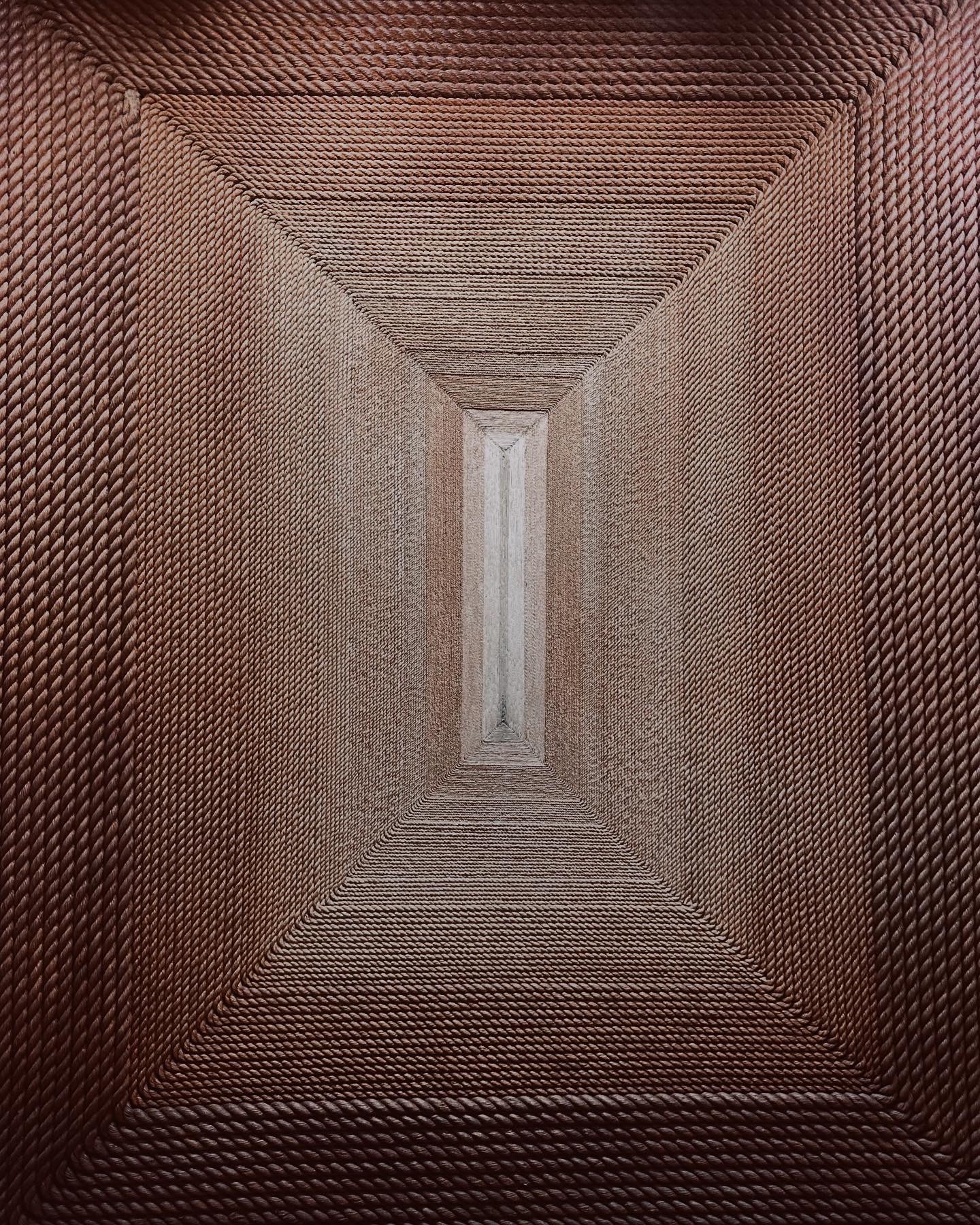
In 2004, a sink hole appeared near the base of the Temple of the Plumed Serpent at Teotihuacan. Past the sink hole, archeologists discovered great stone slabs sealing off what ensuing years of excavation revealed to be a three-hundred foot long tunnel leading into (or out of) the pyramid. The tunnel’s walls are inlaid with mercury and pyrite that lets off nebular glimmer in torchlight. To traverse this tunnel, our guide informed us, was to experience the transition from outer to underworld.
Bardos figure prominently in the book I’ve been working on, though I wouldn’t have known to call them as such before now. The word bardo is Tibetan, which I also wouldn’t have guessed, for no good reason apart from the sound of it, with that hard ar. But the tibetan script is a near clone of sanskrit; it is from sanskrit that the bar in bardo gets its voiceless trill.
“The rule is, jam to-morrow and jam yesterday—but never jam to-day,” the Red Queen tells Alice.
I think of Irving, indignant on the way to school: “ But why is it never tomorrow today?”
In truth, I am much less interested in equal and opposing than I am in between. I wanted to walk this physical bardo and come into its vaulted cathedral with my old willpower, my old clarity of purpose. Also: immune to gephyrophobia.
*******
We return from the pyramids into the dappled hush of the city and eat vegan chilaquiles, slippery with mushroom and sturdy poblano mole, and admire the many dogs of all sizes that heel and lay at attention among the roots of a giant sweetgum tree in Parque Mexico. I buy a new notebook and a brand of italian pens from a cobalt-blue stationary shop in the leather district and sit on one of the benches along the interior allee of Durango Street and start to write about the tunnel. But I am all too easily distracted by the jacarandas. From mid-February to April, the trumpet-shaped blossoms are one of the city’s defining features, for all they were only introduced in the 1930s, by a renowned Japanese landscape architect and gardener who had for decades been transforming the grounds and forest around Chapultepec Castle and providing floral arrangements for the city’s Porfirian elite. The jacarandas are the sort of amethyst blue, crepuscular blue, that demands your attention: lambent, astonishing. They are everywhere and the light that streams through them is almost religious. But no sooner have I written this down than I spot a fruteria cart and get up to order a plastic cup of fat white jicama spears, livened with lime juice and glittery red tajin. The two women behind me, dressed crisply, in skirt suits and low heels, with little badges clipped to their blazer pockets, chat with the vendor as I hunt for a lower denomination of peso. How is her grandmother doing? Out of the hospital?
“She is gardening again,” the vendor says.

*******
It occurred to me that, had I been able to go back to my childhood self and tell her that one day I would live in a place where rabbits and deer eat side by side peacefully, the child would be incredulous: certainly no real people could live in a fairy tale like that?
…
Had I been able to go back to my childhood self and tell her that one day I would live as a mother who has lost a son, the child would be equally incredulous: surely such things happen only in fiction, to characters who are much more interesting and tragic?
So writes YiYun Li, in a 2023 essay for the New Yorker, on losing a child, and what comes after. The essay is structured around a garden: shuttering when the family, newly one fewer, arrive in Princeton, New Jersey. Like Cordelia’s hawthorn tree, the garden is unforthcoming about its future self.
Li, those early winter months, cannot read fiction, with its “palpable presence of the alternatives.”
What she can read is Katharine White’s columns on gardening, and her correspondence with fellow gardener and garden writer Elizabeth Lawrence. These two women, writing to eachother for years and in all seasons: an assurance that spring will come.
Spring comes. Timorously, the garden makes itself known. In increments, Li makes it her own.
The first essay, in my memory, is a sketch around and following the death of the first son more than it is about him. The death is bracketed, and flowers grow against and over the brackets.
Li’s second son is in the first essay so glancingly I did not recall his being there at all. Perhaps the elision is protective; when the first essay was written, the second son was still alive.
The second essay, occasioned by the death of the second son, says more about the first. A beautiful child who dressed in pink and kept his black hair long and liked to walk the two miles from the school in California to his house, armed, at his mother’s insistence, with pepper spray. The spectre of suicide was there for years, almost from babyhood. And yet:
“What can a mother do, facing reality, facing unreality, but rely on her intuition while at the same time keeping her intuition at bay?”

Li does not think, consciously, that this spectre is indiscriminate in his hauntings. And yet: she is unsettled by her younger son’s request, at thirteen, for her copy of Anna Karenina. Yet: there is the line from Camus’ Caligula that has caught in their minds: “Men die; and they are not happy.”
“How does one ever recover from that line?” she asks him.
Her second son’s death veers from his brother’s only in choice of train station.
These essays are not angry. What they are is anguished. Anguish, filtered through a laconic writer, a writer known (to me, at least) for the fearless, unparented children in The Book of Goose.
“Etymologically, “anguish” comes to us from the Latin angustia—narrowness, lack of space, narrow space, narrow passage, strait, limitations, restrictions, confinement, imprisonment, restrictedness, shortage, scantiness, critical situation, narrow-mindedness, pettiness.”
And yet: in this second essay, she says a choice she made as a parent was to respect her children’s originality; as a household, the family enshrined free will. The opposite of narrowness.
The second essay is harder to read than the first. My own reasons for writing about them are not bracketed; I am glad they are there just as I wish they were not.
*******
I sign up for George Saunders’ Story Club substack just in time for The Death of Ilan Iloyvitch. More death! Iloyvitch, the dying accountant who realizes his adult life has been hollow, his obsession with comme il faute leaving little below the surface. But, also: Iloyvitch, who bucks Camus’ dictum by living authentically on his very deathbed.
“A line is always a reaction to the one that came before,” Saunders writes, in an essay, prompted by a reader’s query, titled Is the Sky Ever Green?
In Through the Looking Glass. Alice dreams of the Red King, who is dreaming of her, and Tweedledum warns her that if the King awakens, she will go out (bang!) – just like a candle, because she is no more than a dream of the King she is dreaming. At work, I’ve been playing with markov models, in which each step in a sequence is entirely tied, wholly tied to its precedent. This seems bold, and rash, but then: the same applies to the precedent and its precedent.
Elizabeth Lawrence, to Katharine White: “If I have to hear flowers talk, I would rather read Through the Looking-Glass, which is my favorite garden book.”
We come home to wind’s aftermath. The uprooted pines around the nature center where the kids and I like to walk slump drump and groaning, one against the other. The pines are green, sure, in a sullen way, and the fields are dun and roan and sunny, the kids blending right in in their road salt-colored fleeces, their wintered blonde hair. The first daffodils have poked through the sunny bank of the sidewalk.

This is how I always think of it here: desaturated, violet instead of purple, faun instead of gold, moss instead of verdegris or emerald. Is this why my children, too, flock to navy over royal, maroon over red? Have I consigned them to a lifetime of circumspect palette?
*******
Long Island Compromise is concerned with the inescapable automata of inheritance, here compounded by a rare trauma – a kidnapping – that is never spoken of or dealt with. Carl Fletcher, a second-generation styrofoam magnate, the only son of a man who escaped Nazi Germany with nothing to his name but a stolen formula for a revolutionary new packaging material, is one day kidnapped from his own driveway in Middle Rock, Long Island. He remains in the custody of his kidnappers for five days. “It happened to your body, not to you,” his mother says, when her son is returned. “You are not your body.”
Indeed, Carl, for the next four decades, is pretty much only his body; specifically, his kidnapped body, hooded, bandanna-gagged so he could not swallow, handcuffed to a pole in the basement of his own factory. His own factory! The experience, unexorcized, destroys the family: a dybbuk in the works. Carl’s wife cares only for him; Carl’s children obfuscate, self-medicate, form no lasting attachments.
Carl’s third child, his daughter Jenny, is obsessed with ouroborus, the snake eating itself. She is the child born after the kidnapping, the brainy one, the one the other Fletchers and pretty much the entire town of Middle Rock thinks can do anything, be anyone. But the manifold potential that thrills and drives Jenny as a child become, as she nears adulthood, increasingly paralytic. She sleepwalks into becoming an accidental folk hero to the members of Yale’s graduate student union, and then takes up its causes with singleminded zeal. A decade in, the stakes have lessened, and Jenny, who never finished the doctorate in economics that had drawn her to New Haven in the first place, is still the union organizer, still in her student apartment, still lathered – until she isn’t. She has lost her oppositional conviction, and sleeps for weeks, months, until, at some point, she is no longer the union organizer. But the snake does not let fall its tail: she returns to her father’s factory, to her childhood friends, to her high school boyfriend, recently divorced from his first wife, another Jenny.
This is how Long Island Compromise ends: not with revolution but with return. It’s an ending that is, in what it says about consequences, and wealth’s vise-grip, as terrible as the author warns us, on the very first sentence, that it will be. It’s also the best ending I’ve read in years: fantastical, antic, absurd. There are not zero similarities to Louis Sachar’s Holes’, a book I love to read aloud for those same qualities.
*******
The prospect of all this inheritance can make a mother nervous. When my children flap and dither, or get distracted in the middle of lacing up one shoe; when they are rigid in their expectations – I see myself. When they are affable, gregarious, prone to hugs – I see my husband. But mostly, they are themselves.
At night, Perry writes by moonlight until he’s ready to sleep. In the morning, he picks up where he’s left off. His magnum opus concerns four echidnas whose powers – strength, speed, courage, intelligence – combine to form The ULTIMATE GEMSTONE. The ultimate gemstone “has the power to turn ideas and dreams into real,” and, as such, is the object of great desire and the subject of pitched, axiomatic battle.
There is a sunny day in mid-April, one of the first days I’m out on the porch, when Perry and his friend Ada bound in.
“Mom, mom, get up. We want to show you something marvelous.”
Obediently, I shut my eyes; allow myself to be led, stumbling in my sheepskin slippers.
“No peaking,” Perry admonishes. I protest. Surely my unsteadiness is evidence that I have not. Perry’s hand is damp and Ada’s is dry. I feel like Helen Keller, I say.
She couldn’t hear, either, Ada reminds me.
The marvelous thing is a hole, a foot wide and twice as deep, which I don’t so much pitch as slide into. Actually this is the marvelous thing: that the seven year olds have successfully trapped their absentminder.
At home, I’m going to hang up some bag or another, sisyphus battling mudroom entropy, and then stop. A small, round bird with calm brown eyes and a long, curved beak stares at me from the depths of a nest she’s fashioned from moss and pine needles, set into the entrance of an old bucket bag I’ve had since high school. I stare back, longer than I ought to, and then break myself away. Our mudroom is: unfinished, heavily trafficked, lit by crude overhead lights we generally fail to turn off. I turn them off.
My mother tells me the bird is a carolina wren. Everyone says they love her. Everyone warns me not to move her.
I, too, love her. I will not move her. In the morning I will steal into the still shadowy room and see if I can make out her bright eyes.

It’s mid-April and then it’s May, somehow. The kids challenge me to see how far I can walk with all three of them spangled on my back: three steps. I teach them the words to “I Will Survive”, thinking it’s all chorus; discovering, as I feel for each verse, that the chorus hides. Under a soft fingernail moon I walk past he tennis courts, where one straggler serves, rhythmically, to no one. A couple of kids play hard country out of the snack shack by the ball fields: Ain’t no love in Oklahoma / Just the whistle of a long black train You’ll know when it’s coming for ya / Riding in on the wind and rain.
A fingernail moon and profligate stars, high-beam Venus, Jupiter and the north star not to be outdone. What did Emerson say?
If the Stars should appear one night in a thousand years, how would men believe and adore; and preserve for many generations the remembrance of the city of God which had been shown! But every night come out these envoys of beauty, and light the universe with their admonishing smiles.
Every night over one in a thousand: I’ll take it, no contest at all.
 éclaircissements
Leave a comment