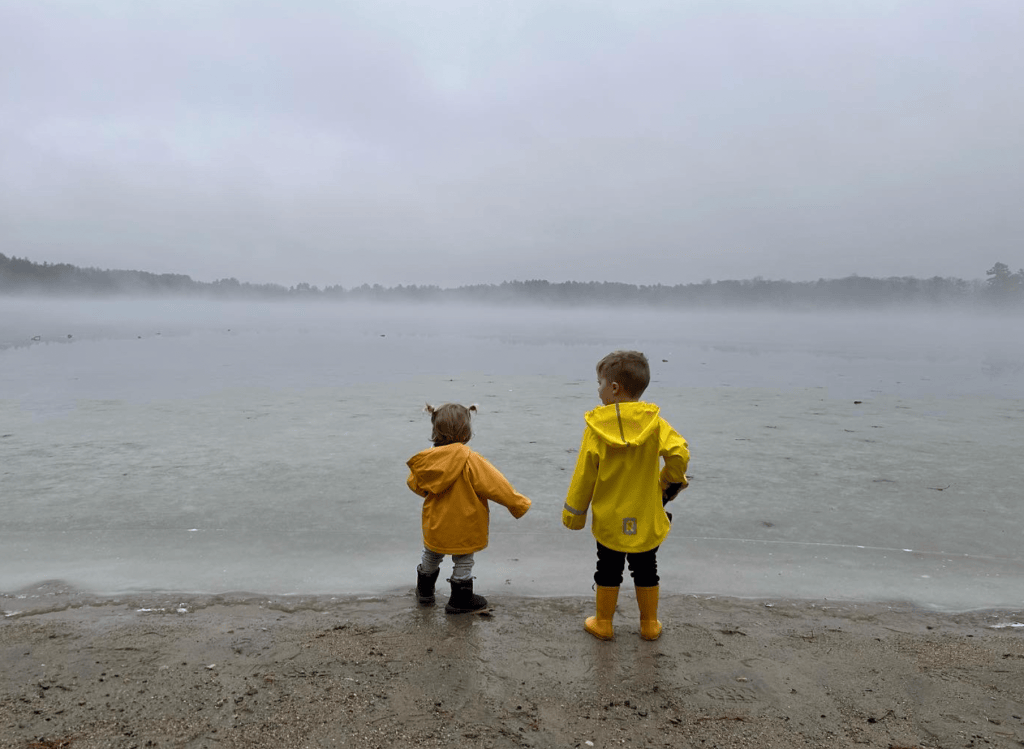
The thing is / if you were a mother of three young children / in Massachusetts in late January of 2023:
You didn’t forget this case.
You couldn’t shake it for a month, which is nothing; nothing in the scheme of things; this isn’t about you. It’s just —
That January, the sun didn’t show for three weeks. Oh, it rose; I’m not saying the rules of the universe bent – but you wouldn’t have known it; the scrim was that thick. For three weeks, it was just grey, and warmer than usual, pattering rain and mist, so that your back yard looked like March, beleaguered, and there wasn’t any chance of sledding. You’d gotten through the gauntlet of the holiday break only to find you were still in it; the kids kept getting sick; you hadn’t taken them anywhere to demarcate the year; you were always home, and it hadn’t snowed and it had rained and drizzled and it seemed like it would keep doing so forever.
But your children, though young, were not as young as they’d once been—2,4,6, if only just 6, barely past 4. If it had been the previous year –
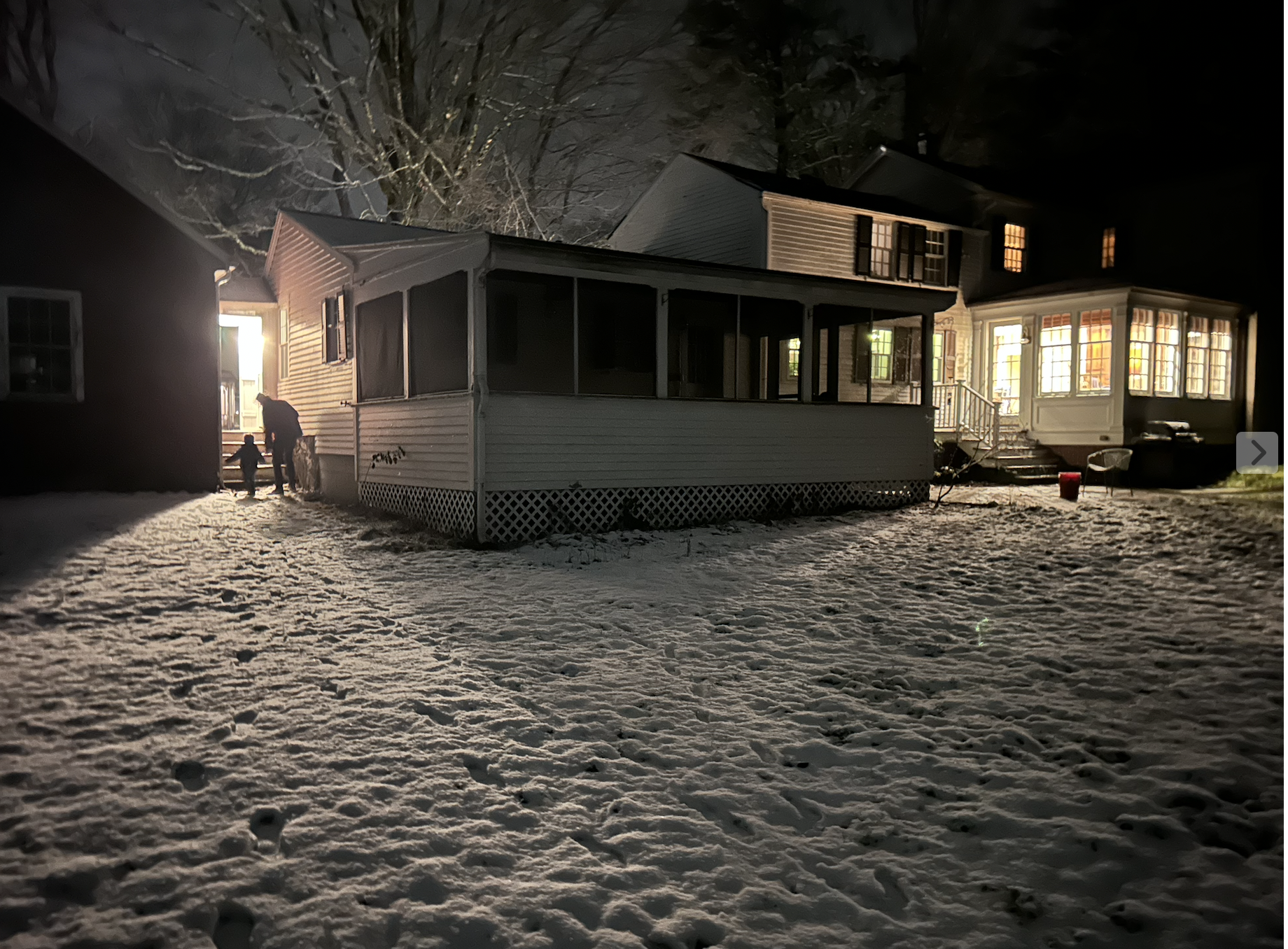
The coverage, at first, is guarded. The photos, apart from the one of the blue gambrel cape in the thin white snow with the caution tape, are befores. It is hard to look at the pictures of the children, and you mostly don’t. Without details, you are able to hold the story at some degree of distance.
It is only when the Globe publishes a photo of the mother in her hospital bed, that the distance collapses. It’s the first night of a work team ski trip you’re hosting at your family’s house in Vermont, and it’s late, closing on midnight. The others have just gone off to bed and you’re puttering around, slightly stoned (a bad idea, in retrospect), waiting for the fire to be well and truly banked.
You see the photo and right away you click your phone dark.
Click it back, of course. You are writing this now, several years later, and you cannot go look at the photo again, but you wrote about it at the time:
“It was the sort of shot I could imagine an aggressive photographer taking as he was hustled back out of the hospital room: disturbing, dehumanizing, with little point beyond giving us a new and much bleaker visual for what the mother looked like. The prior photos – smiling headshot, lively brown eyes – established dissonance with the act, intentionally or not. With this one, the Globe seemed to have changed stances, from one of sympathy to something harder-nosed. Where there is madness, there is method, the photo, the accompanying headline, the lede text implied.”
More developments accompany the photo, details about the children and the manner in which they died, and these, too, are blunter in their delivery.
You can’t think about it or you’ll never sleep, but it’s pretty much all you can think about. The next morning, and the morning after that; on and on.
Get rid of the exercise bands, you tell your husband. You are still in Vermont, still, running up a hill called Skiparee, and the developments are burred in now; unshakeable. You can picture the bands, neon yellow, hot pink, a fatter, shorter black. You can picture them, but not where they are, which you will obsess over for the next few days, until you remember that they are in a duffel bag that also holds old halloween costumes, for some reason. The heat has fused yellow and pink together. They go into the trash, and then you cut them up into very small pieces, exercise band confetti, almost, and put them in the trash again.

There was a period in fifth grade where I wouldn’t sleep on Wednesdays and every other weekend, for fear of intrusive thoughts becoming real. These were the nights we were at my father’s house, and I was sharing a room with my younger sister. I’d never shared a room before. Intrusive thoughts were not the same thing as voices; they were my mind running away with itself, pursuing a terrifying hypothetical I had no interest in realizing.
I was reading a lot of Steven King at the time. Carrie. Pet Cemetery. IT. I had exhausted the Sherlock Holmes and Agatha Christies, which would, in their neat configurations, have been the right sort of distraction. I liked solving mysteries; they were like multiple choice exams, only they toyed with A, B, C, D, E, revelling in the brilliance of C, of B, before pouncing upon A, heretofore the blandest option, now made dazzling for its having been so long overlooked. Horror was different; it was meant to be endured, rather than solved.
I forget how long this went on, how many sleepless nights. Not so many. Enough that I, an exceedingly guarded child, thought about telling – well, I didn’t know. But I didn’t.
I’m speaking for myself, even if it’s true that not one of us forgot, even if the ways we engaged with or couldn’t engage with the case varied. For some of us, it was too close. This, I understood. I was lucky, being a year past any of my children being true infants. And still, I couldn’t sleep, and when I tried to, all I could think about were the mechanics. Or, rather, the mechanics were the sinkhole I tiptoped around.
For all its fantastical filigree, horror is just reality pushed to its intrusive limit. In a mystery, the event is discrete; horror is continuous; its half life is long, even asymptotic. It felt, during the trial, like mothers all around the country were trying to convince themselves that this was a mystery. That it was a whodunit, even.
In This House of Grief, the Australian novelist and reporter Helen Garner wrote about her experiences covering the murder trial of Robert Farquharson, who on Father’s Day in 2005 had veered his white Commodore off the road and into a very deep dam, drowning his three young sons. Farquharson himself had survived, and had acted strangely in the aftermath; had been considered by one of his therapists to be “mildly to moderately depressed,” though he had admitted thoughts of suicidal ideation.
Garner’s reluctance to join in the consensus her fellow journalists reach nearly from the jump of a trial whose evidence seems overwhelmingly tilted towards a guilty verdict, is born not of fact but of a very human magical thinking:
“…if only Farquarson could be found not guilty, then the boys would not be dead.”
No one following the Farquharson case, Garner included, seemed inclined to find someone else guilty in place of the father. The fathers Garner spoke to referenced Farquharson with scorn and anger – they’d have rescued their children! – and, more rarely, scorn and anger and doubt (they’d have rescued their children, they hoped).
I behaved poorly when confronted with conspiracies about the Clancy case. To put it plainly: engaging in conspiracies about a father who came home to find his 5, 3, and 7 month old strangled to death with exercise bands and his wife paralyzed and bleeding in the thin snow is disgusting, and cruel.
I behaved poorly – pushing rigidly back, feeling myself grow heated and snappish, even as I knew that the source of the conspiracies’ appeal was not voyeurism, or ghoulish interest in true crime, but something far more protective. Don’t let her have done it, because she is I is we is us; her act opens doors that must stay shut, just as her asking for help is our asking for help, our relief mixed with rage mixed with worry when we are told we don’t need help, not that kind, not to that degree. The burden it would place on the systems in which we are intractably centripedal! An unfathomable fact, The New Yorker called it, but we could – almost – fathom it: the illogical conclusion.
The only good that could come of a trial like this, a case like this, is in its capacity to prevent future such cases. (Just a few months ago, a similar case occurred, less than two miles from our home.) I worried that twisting horror into mystery – continuous into discrete – might dampen the state’s enthusiasm for improving access to post-partum mental health services, and ensuring providers coordinate care.
The trial ended in a mistrial, but the state, at least, is proposing $2M be added to the budget to fund voluntary nurse home visit services to all families with newborns, and another $250K to be set aside for the Massachusetts Child Psychiatry Access Program for Moms. There are efforts underway to add Postpartum Psychosis, which Clancy claimed to suffer from, and which she was not treated for, to the DSM.
Patrick Clancy and his new wife are on 60 Minutes tonight. Are we away, still, on the high seas of narrative? How I hope not. For his sake, and for our children’s (and okay, for ours, for ours!).


Leave a Reply