My middle child spent the first night of his eighth year in the emergency department of Newton Wellesley; he’d fallen off a slide, or been pushed backwards; the mechanics were not clear, and I had been only partly listening when they had been narrated to me by an adult; the children had tennis lessons, and we were running late, and the brightly colored waterbottles were dispersed like sentries across three corners of the near playground, the lunchbags unzipped and threatening to disgorge their tins and fruit leather wrappers; Ottelie’s most precious key chain, of a stuffed pig in a tutu, spun wildly from a monkey bar. Fell off a slide, I said, anxious to be going, right, into the car; we’re late; we’re late; prying Ottelie from the coven of first grade girls with their big, grosgrain bows, retrieving the keychain, chucking waterbottles into the back. Irving was holding his racquet by the head; stabbing at the air. I’m a swan; sssss.
It was evening, darkening quickly as I struggled up the walkway to the emergency department lobby, Irving piggyback, mewling whenever his stomach came in contact with my back, which was often. Why had I parked so far away? I have unceasing skill in this respect. It was a Friday; I steeled myself for the lobby to be chaos, as it had been the year before, when Brady, on the brink of meningitis, had waited 6 hours on one of the vinyl chairs; the last two without me. But it was calm; we waited only minutes, Irving vertiginous on my lap, before we were seen.
Sometimes / I dream / of green / ice cream!
Remember that? I ask. This is the first couplet of a poem he wrote in kindergarten.
He is in pain, but he marvels. Green ice cream! How did I think of THAT?
I think, quite often, that I am skating along the periphery of my children’s’ lives; that I will do so in perpetuity – only illness and injury offer brief interregnums. So it is in the children’s hospital; where I also feel, however luckily, that here is the collective, working as it should.
Did you know someone flew a plane into a tower today? And then someone else flew into the other tower, right after?
This was the twenty fifth anniversary of 9/11. Earlier, I had told Irving and Peregrine the broad outlines of the day’s events: two towers, four planes, three thousand deaths, a gaping hole in the left cant of the Pentagon, a field in Shanksville, Pennsylvania. How the fourth plane was supposed to hit the White House, but the passengers fought back. I could sense that I had been right to tell him; that he was absorbing the information not as some macabre bearing on his own birth but as a mnemonic of sorts.
We were outside radiology, waiting for a cat scan. The nurse who had brought us down from pediatrics wouldn’t let me help him push the gurney; I got it, senorita, he said; gotta get my reps in, see?
And now, to Irving, he said yes, he did know; he remembered; couldn’t forget something like that. His brother had enlisted right after, and he had too, once he graduated.
Irving sat up straight, forgetting that his stomach hurt. He wanted to know about the nurse’s weapons – did he carry a gun? He did. Did he have to shoot anyone? Irving – I interrupted. But the nurse smiled. You don’t want to shoot. You want peace.
But did you?
Yes, the nurse said. I admired the matter-of-fact way he was answering these questions, without looking to me for permission.
Irving had no discernible trauma, or other injury. All that seemed to be wrong was dehydration. For hours, he had not been allowed to eat anything, and he fell upon the box of plain cheerios and two packets of graham crackers while we waited for the discharge papers.
We left the hospital, me carrying Irving down the steep path just as I’d so recently carried him up. Irving chatty, full of theories. I can’t be a doctor, because I need sleep. Did I just fly the speed of sound in the cat scan? Did my particles?
Did you go to this hospital when you were a kid?
A few times. But I was in high school. Not really a kid.
Did you have a stomach ache too?
I thought about what to say. I allowed I’d been dehydrated.
Like me!
Not so smart as you.
“You shouldn’t look this good,” my mother’s then partner told me, after the second hospital visit. I had been on an IV drip all night and felt thoroughly rejuvenated.
“Next time, tell the nurses no IV drip,” he added, to my mother. I brushed that off. The next time would be in Paris, and there would be no IV drip; the french took a more spartan, dismissive view of drunk teenagers.
The first time, I had felt – I couldn’t remember. Probably not bad enough, considering there I was again, not seven months later.
(But in those seven months, I had lost my sense of smell, and developed a strange habit of stopping in the middle of races. By April, I had stopped swimming altogether.)
What toys did you pick, when you were here?
I was too old, I said. Though the correct answer was: the IV drip.
Did you pee in a hat?
I said I didn’t think I’d been given a hat.
This has been a very good birthday, he said, in the car driving home. My particles spun around and I got to play with a switch and drink orange soda and you know what else?
What else?
I haven’t even opened my presents yet!
A very good birthday, then.
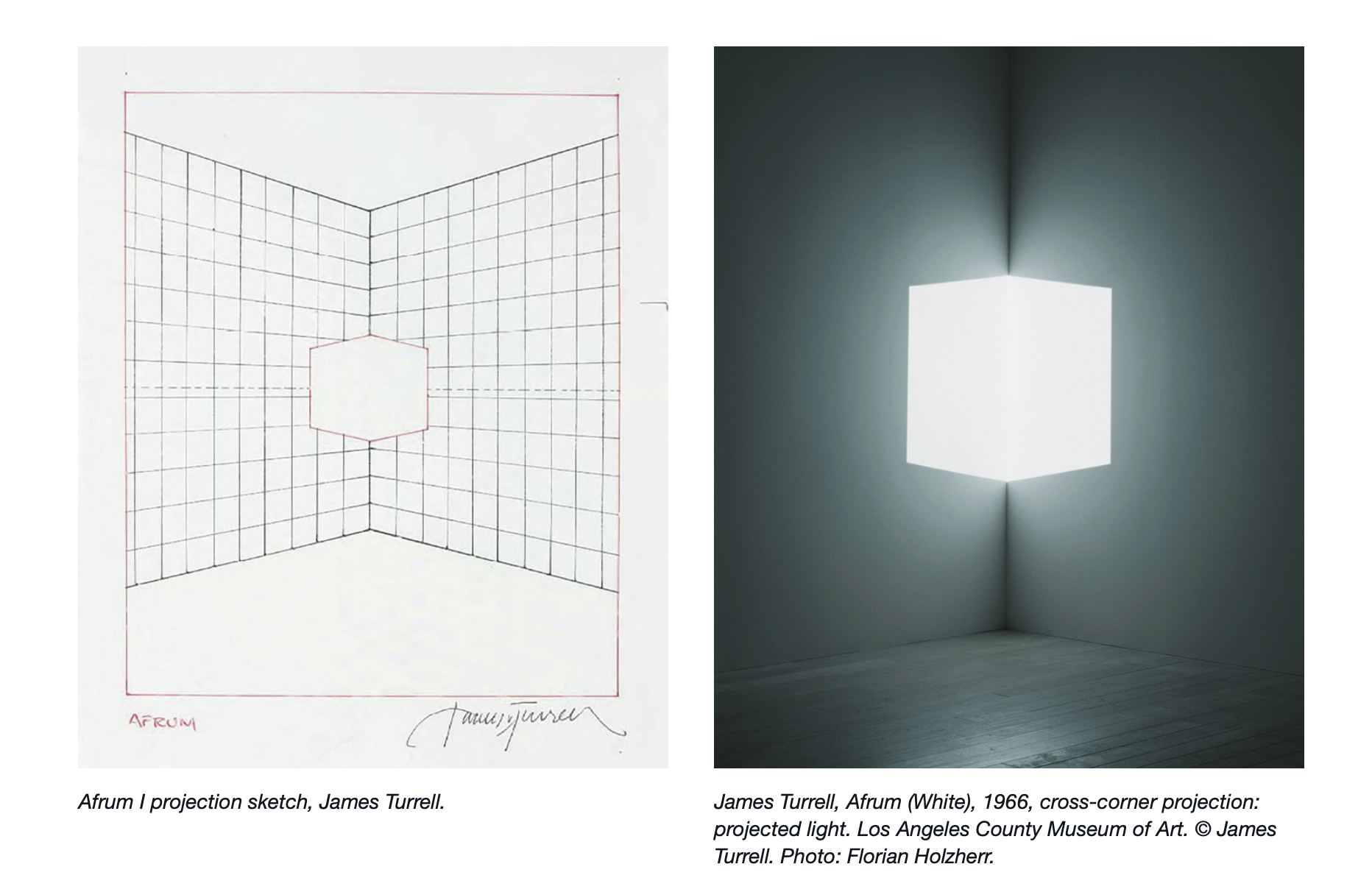
The artist James Turrell has spent the last half a century tunneling into a dead volcano in the Arizona desert, reconfiguring into – what? Some sort of modern-day pyramid. Just like a man! Before that, he was intrigued by the interplay of light and space on more humble scales: what did lying directly underneath a narrow slot that had been excised from the ridge of a water tower do to the way the eye experienced the sky? Could you, in fact, tell that it was the sky, and not some painted swatch of: dove | shell | lapiz | duck egg | neon green | acid yellow. Acid yellow sky!
He liked to add dimension to what was flat – not even flat but optics! and remove from what was solid, and even grand; whether or not his point was to shake you, the witness, out of yourself and your world and your reproduction-glutted ways of seeing, that was the effect.
My friend and I inched our way up a ramp into a yawning black maw – vanta black. This was Hind Sight, and we hadn’t intended to go; we didn’t know what Hind Sight was, or who James Turrell was; a docent had approached us as we’d entered the wing of Mass MoCA that has housed the nine installations that make up Into the Light for nine years. The docent was excited and focused. There’d been a cancellation; two spots had opened up. Did we want them?
We understood we were being offered a gift – the lift of luck, having not made reservations ourselves.
I looked at the black hole in the wall, and then at the opening beside it, which emitted a radiant, shifting light blue. This was Perfectly Clear. It seemed like the safer bet.
The ramp abruptly pivoted, as we’d been warned; still, our hands slipped from the railings and we had to feel our ways back. We found one seat – but where was the second? My friend seemed miles away; I reached and nearly staggered into her hand. I was frightened and very thankful for the company; it engendered a sort of mad, panting gaiety that subsided into contemplation as our eyes adjusted. Adjusted may be the wrong term: there is nothing to see in Hind Sight; you are adjusting to absence. At first, you shut your eyes and open them and there is no difference at all; the purple splotches move indistinguishably from one to the other. I waved my hand in front of my face; nothing. I see green! my friend exclaimed. I did not see green, nor blue; the purple splotches diffused, very slowly, into a more uniform stygian grey. There’s light coming from somewhere, my friend said. She could see it in the very corners of her eyes. I waited, but it was only that purple grey, and very gentle, and then, from a distance, we heard the docent’s voice, telling us the 15 minutes were up.
Holy shit, I said.
We walked more easily down the ramp, into the light. The docent, beaming, directed us to Pink Mist. We’ve seen that one already, I said – it had the narrowing black aperture of Hind Sight, but then opened into a glowy pink red box; the pink splotch on the wall seemed flat, at first, and then the light detached, it pulsed about us, nearly a mist to it. I had followed my friend Z across the carpeted floor to the pink splotch, both of us crawling. But then I had grown accustomed to it; half our group, Z included, had not; they wanted out.
Try it again, the docent said. You’ll see.
And that was maybe the coolest trick of the whole experience: we strode into the womb room; the aperture was no longer black but mild grey; we didn’t need the hand railings at all, and in the room inself, we could see the bench for sitting, and the outlines of the cutaway from which the pink light emanated. We could see everything.
*from Jessica Fisher’s poem Inmost, in the polyphonesthemic collection of the same name.


Leave a Reply